 Risk Level Classification System (Smart Diagnosis)
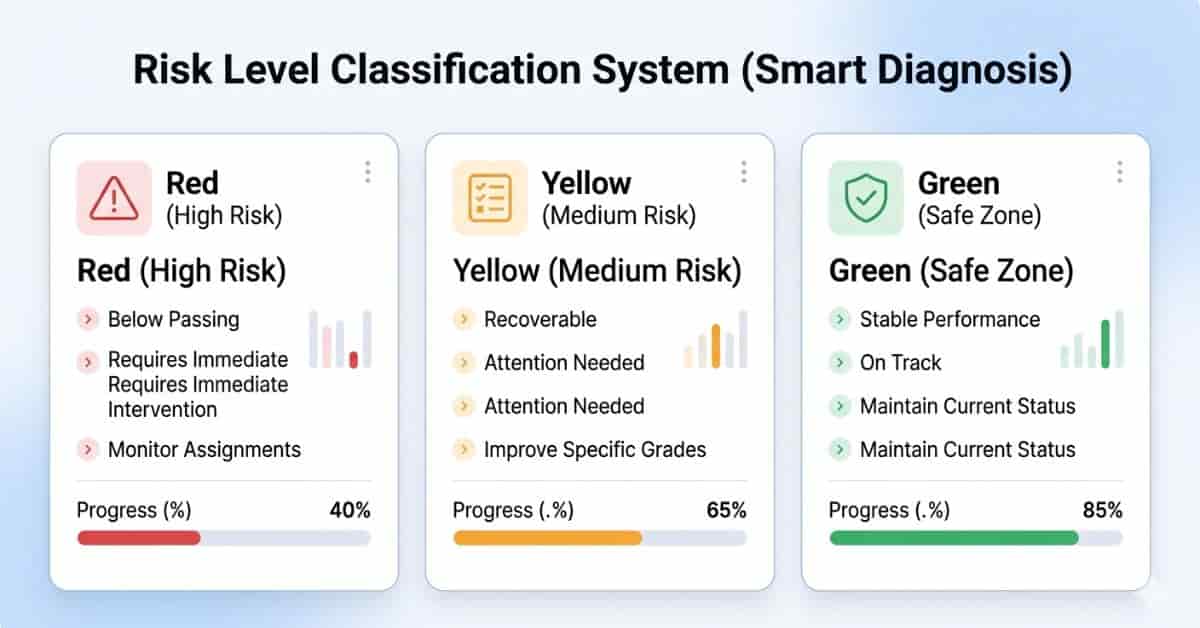
Once you understand your current grade situation in Canvas LMS, the next step is to classify your risk level. This is important because every recovery strategy depends on how serious your situation actually is—not just your percentage.
Most students make the mistake of relying on emotion (“I feel like I’m failing”) rather than on structure. This system fixes that.
 High Risk (Critical Situation)
Situation:
- Below passing threshold (usually below C or the required minimum)
- Multiple major assignments are missing.
- The final exam is heavily dependent on survival.
What this means in real life:
You are in a damage-control phase, not a normal study phase. At this level:
- Every remaining assignment matters significantly.
- You cannot afford to ignore even small marks.
- Your final exam becomes a “make or break” component.
 Reality: You are not out of options, but you must act immediately and strategically.
 Medium Risk (Recoverable with Strategy)
Situation:
- Some assignments are missing, but not all of them.
- Mixed performance (some good, some weak scores)
- Final exam still has a meaningful impact.
What this means in real life:
You are in a recovery zone, which is actually the most common student situation.
At this stage:
- You still control your final outcome.
- Smart prioritization can quickly improve your grade.
- Small improvements create noticeable grade jumps.
Reality: You don’t need panic—you need prioritization. Safe Zone (Optimization Stage)
Situation:
- Currently passing the course.
- Most assignments completed
- Grade is stable but not final yet.
What this means in real life:
You are in a grade improvement phase, not survival mode.
At this stage:
- You can upgrade your grade from C → B or B → A
- Small mistakes can still affect the final GPA.
- Focus shifts from “passing” to “maximizing performance.”
Reality: You are safe, but optimization decides your final result. Key Insight
Your risk level is not permanent. In Canvas LMS courses, it changes every time you submit an assignment or take a test—so your strategy must adapt accordingly.
 How Canvas LMS Grade System Works
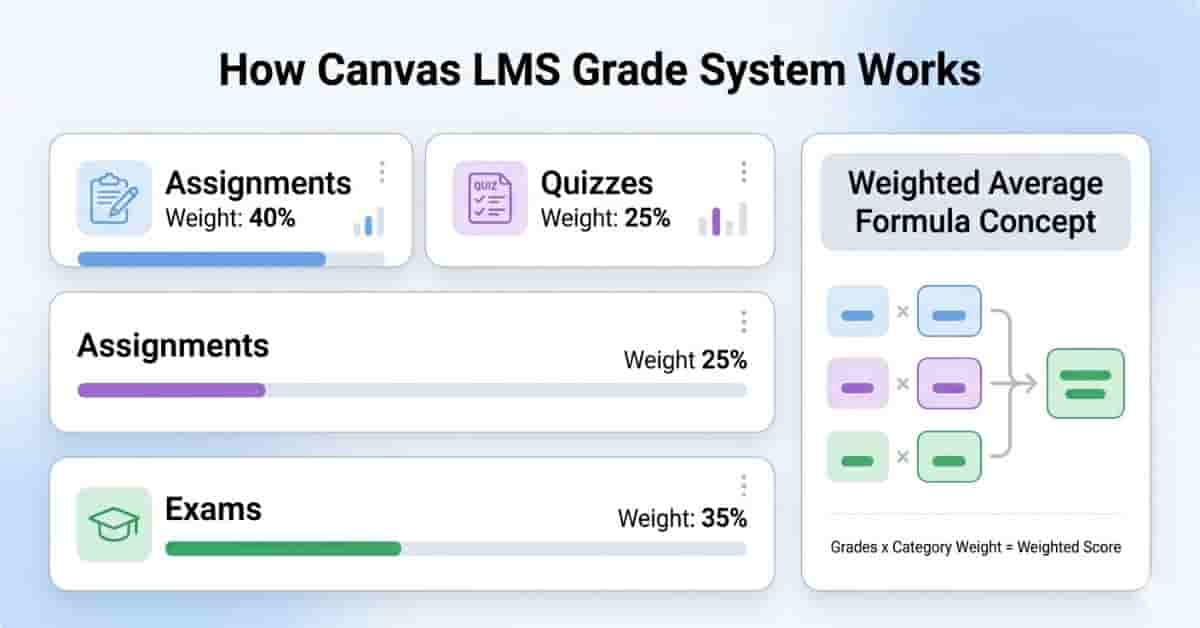
To improve your grade, you first need to understand how it is actually calculated in Canvas LMS. Many students assume the percentage shown is final, but in reality, it is a constantly updating weighted system that depends on multiple categories.
This section explains how your grade is truly built—and why your current percentage may not reflect your final outcome.
 Weighted Grading System (Assignments, Quizzes, Exams)
Most courses in Canvas LMS use a weighted grading model, meaning different types of work have different importance.
Typical structure:
- Assignments → moderate weight (practice + consistency)
- Quizzes → medium weight (understanding checks)
- Exams/Final → high weight (major grade impact)
Key idea:Not all points are equal. One exam can be worth more than 10 assignments combined.
This is why students often feel “I did many assignments but still low grade”—because they misjudge weight distribution.
 Dropped Lowest Scores Concept
Some instructors enable a “dropped lowest score” system.
This means:
- Your worst quiz or assignment may be automatically removed.
- Only your best performances are counted.
- It can slightly improve your final grade without extra effort.
Important insight:Many students don’t realize their grade may already be adjusted in their favor through this system.
 Late Submission Impact
Late submissions in Canvas LMS can affect your grade in different ways depending on instructor settings:
- Full penalty (deduction per day late)
- Partial credit (reduced score allowed)
- No credit (strict deadlines)
Key reality:Late work does not always mean zero points—but repeated delays compound into a grade drop.
 Grade Visibility vs Real Progress
One of the biggest misunderstandings is assuming that Canvas grades equal final academic performance.
In reality:
- Canvas shows current progress, not the final result.
- Missing future assignments are NOT included yet.
- Final exams can dramatically change the outcome.
Example:A student with 55% mid-course can still reach 75%+ if the remaining weighted tasks are strong.
Generates a structured daily recovery plan based on remaining time, workload, and priorities.
 Minimum Score Needed to Pass (Core Utility Section)
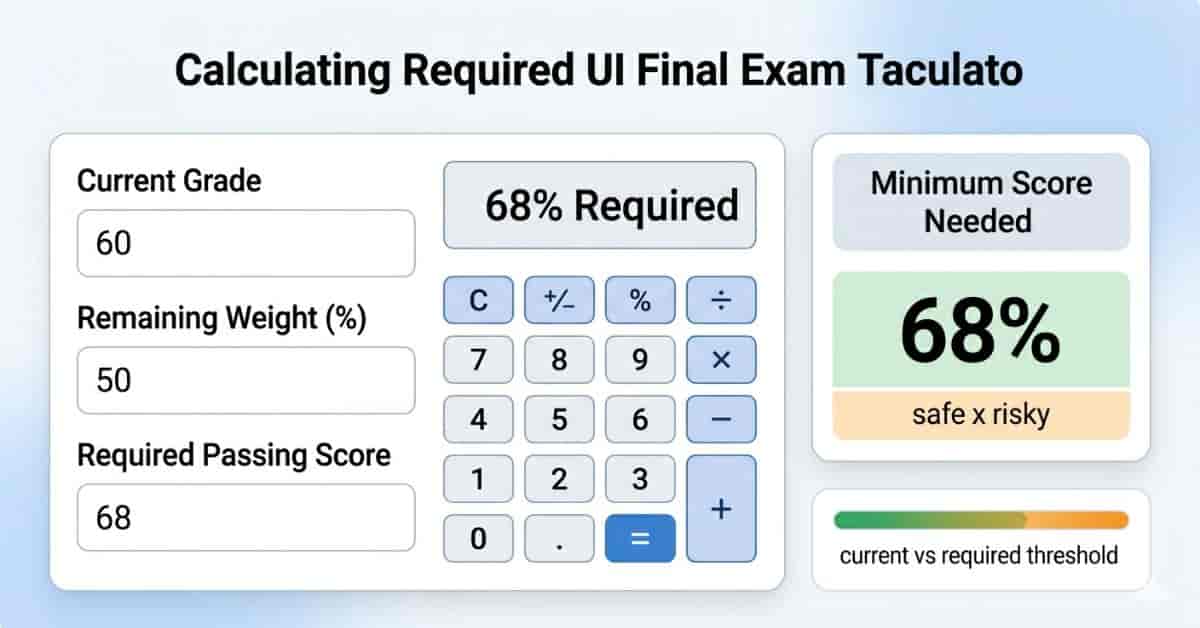
This is the most important turning point in your recovery plan inside Canvas LMS.
Most students stay stressed because they don’t actually know what score they need to pass. They just guess. This section eliminates guesswork and turns your situation into a clear target.
 Current Grade → Required Final Exam Score
Your final grade is not random—it is calculated based on remaining weighted components.
To understand your situation, you need this simple logic:
- Your current grade = partial performance
- Remaining grade = final exam + remaining assignments
- Final outcome = weighted combination of both
This means your final exam score can still completely change your result. “What do I need to score to pass?”
Instead of thinking “I’m failing,” you should ask:
What exact score do I need on the remaining work to reach a passing grade?
In most Canvas LMS courses:
- Passing threshold is usually around 60%–70%
- The final exam often carries 20%–50% of the weight.
Even if your current grade is low, a strong final exam can still push you over the line. Safe Passing Margin Strategy
Don’t aim for the minimum pass score only—aim for a safe buffer.
Why?
Because:
- Grading errors can happen.
- Late penalties may apply.
- Final adjustments may slightly reduce the score.
Smart strategy:
- Minimum pass target → risky zone
- +5% to +10% above pass → safe zone
- +10%+ → strong grade protection
In simple words: don’t survive the course, secure it. Realistic vs Impossible Recovery Cases
Not every situation is equally recoverable. You need honest classification:
Realistic Recovery
- Some assignments still remain.
- Final exam weight is still significant.
- Current grade is not extremely low.
Strategy works here: consistent effort + exam focus Difficult but Possible Recovery
- Multiple missing assignments
- High dependency on the final exam
Strategy works only if:- You maximize remaining submissions.
- You performed strongly in the final exam.
Near Impossible Recovery
- Almost all work is missing.
- The final exam is the only remaining component.
- Extremely low current base score
Reality check:At this point, improvement is limited, and focus shifts to damage reduction rather than full recovery.
 Key Insight
Inside Canvas LMS, your grade is not fixed until the last weighted component is completed.
That means:
Your “final required score” is more important than your current grade.
Helps you convert your current performance into a clear GPA target and long-term improvement plan.
👉Plan My GPA Improvement Strategy
 3-Phase Grade Recovery System (Action Roadmap)
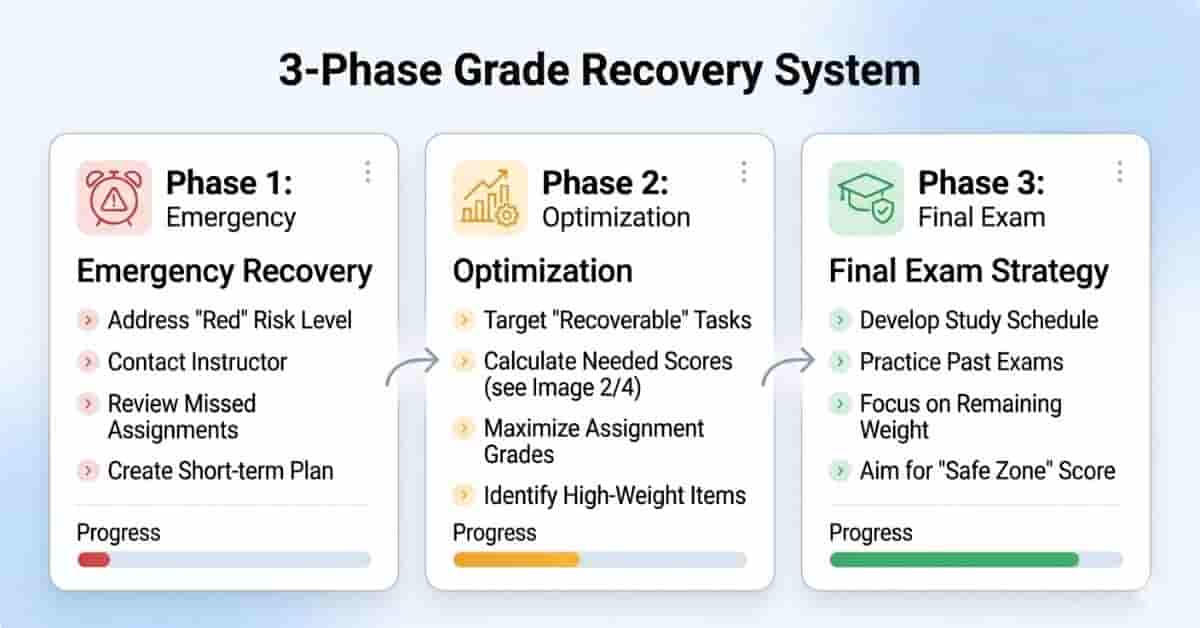
Once you understand your risk level and the required passing score inside Canvas LMS, the next step is execution. Most students fail not because they don’t understand the situation, but because they don’t follow a structured recovery plan.
This 3-phase system turns confusion into a clear step-by-step action path based on urgency and impact.
 Phase 1: Emergency Score Recovery (0–48 Hours)
This is your immediate damage-control phase. The goal is to recover as many easy and available points as possible in the shortest time.
Focus Areas:
- Submit all missing assignments immediately.
- Complete any “easy credit” tasks (low effort, high return)
- Recover attendance or participation marks.
- Check the Canvas dashboard for overlooked submissions.
What this does in real life:
This phase gives you instant grade stabilization. Even small improvements here can shift your risk level from “High Risk” to “Medium Risk.”
Key idea: stop the bleeding first before trying to grow. Phase 2: Mid-Term Optimization (Performance Recovery Stage)
After emergency recovery, you shift into structured improvement.
Focus Areas:
- Improve quiz scores where possible.
- Attempt partial credit or re-submission opportunities.
- Focus on high-impact assignments (not everything equally)
- Prioritize subjects/topics that carry more weight.
What this does in real life:
This phase builds your grade momentum. Instead of random effort, you start focusing on high-value actions that actually change your percentage.
Key idea: not everything deserves equal time—focus on weighted impact. Phase 3: Final Exam Strategy (Grade Deciding Phase)
This is the most critical phase inside Canvas LMS courses because the final exam often determines your final outcome.
Focus Areas:
- Focus heavily on high-weight exam topics.
- Identify the most repeated and important concepts.
- Build a targeted study plan (not full syllabus panic study)
- Maximize score efficiency (high marks with focused effort)
What this does in real life:
This phase decides whether you pass, fail, or upgrade your grade. Even if earlier performance is weak, a strong final exam can completely change your result.
Key idea: final exam is your biggest leverage point. Core Insight
Most students think recovery is about “studying harder.”
But in reality, recovery in Canvas LMS is about:
But in reality, recovery in Canvas LMS is about:
Doing the right actions in the right phase, in the right order.
Priority Decision Rules (WHAT TO DO / SKIP)
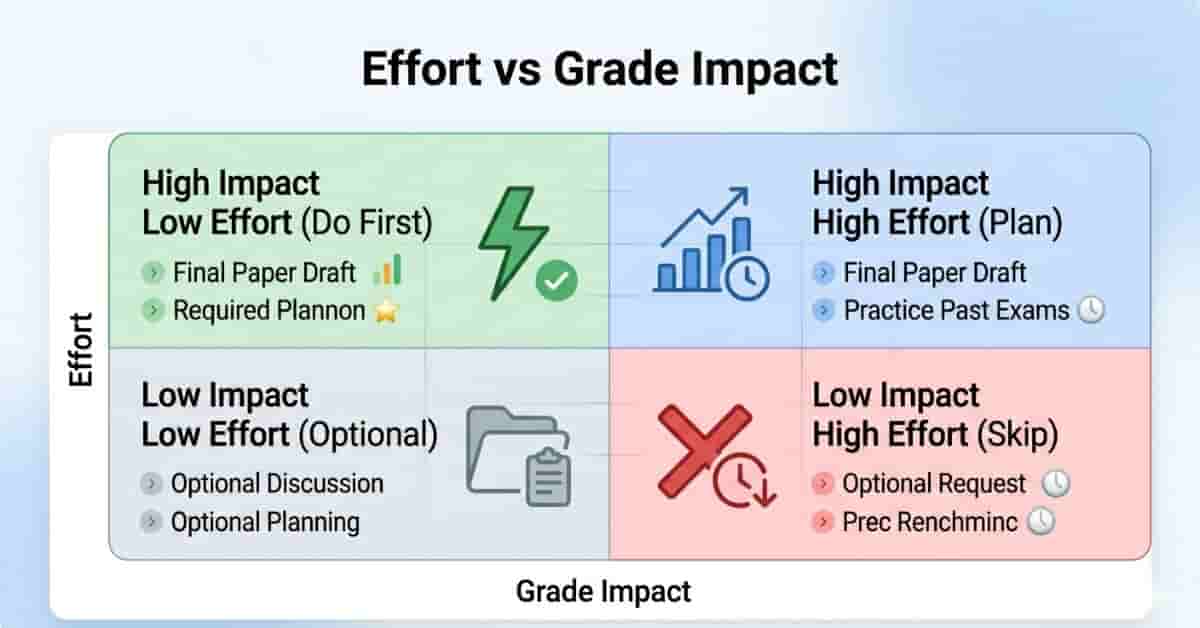
One of the biggest mistakes students make inside Canvas LMS is treating all tasks equally. In reality, every assignment has a different impact on your final grade—and your recovery depends on choosing the right ones, not doing everything.
This section helps you think like a strategist, not just a student.
Which Assignments Matter Most?
Not all tasks carry equal weight. You should always prioritize based on grade impact, not effort.
 High Priority Tasks (Do First)
- Exams and final assessments
- Major projects (high percentage weight)
- Anything worth 10% or more of the total grade
- Assignments that cannot be dropped
These tasks can change your entire course outcome. Medium Priority Tasks (Do If Time Allows)
- Quizzes
- Weekly assignments
- Discussion posts with moderate weight
These help stabilize your grade and prevent further drops. Low Priority Tasks (Optional / Skip if needed)
- Very low-weight activities (1–2%)
- Extra practice tasks with no grade impact
- Repetitive or already completed content
These should NOT consume your recovery time during urgent situations. What NOT to Waste Time On
When you are in recovery mode, time becomes more important than effort.
Avoid:
- Spending hours on low-value assignments
- Perfecting already low-impact tasks
- Over-studying topics that carry minimal marks
- Rewriting submissions with no grade benefit
Key rule: If it doesn’t improve your grade significantly, it’s not a priority. Effort vs Grade Impact Matrix (Smart Strategy Thinking)
Every task should be evaluated using this simple logic:
 High Impact + Low Effort → DO IMMEDIATELY
- Easy assignments with good weight
- Bonus credit tasks
- Quick submissions that recover points fast
 High Impact + High Effort → PLAN CAREFULLY
- Final exams
- Major projects
- Large assignments
These define your final grade outcome. Low Impact + Low Effort → DO ONLY IF TIME LEFT
- Small quizzes
- Minor participation tasks
 Low Impact + High Effort → SKIP (IMPORTANT)
- Time-consuming low-weight tasks
- Over-detailed optional work
These are “grade traps” for struggling students. Core Insight
Inside Canvas LMS, success is not about doing more—it is about doing what matters most.
Smart students don’t finish everything. They finish what changes their grade.
 Common Student Mistakes (USA Behavior Targeting)
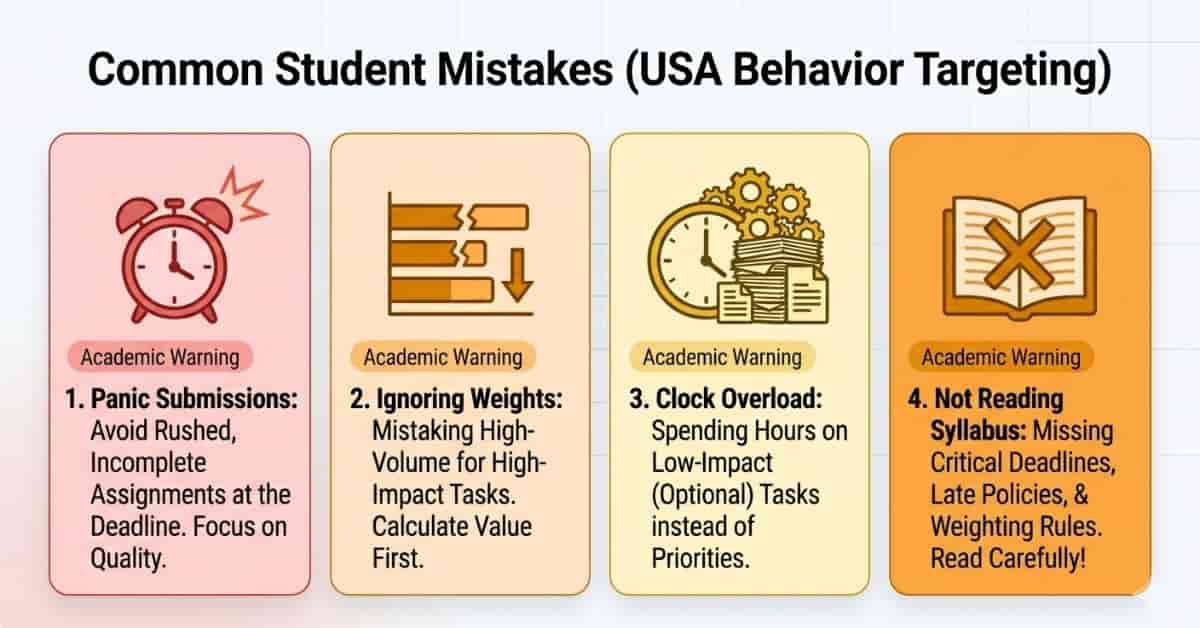
Most grade problems inside Canvas LMS don’t happen because students are “weak” academically—they happen because students follow the wrong strategy under pressure.
This section highlights the most common mistakes USA students make and how they directly damage recovery chances.
 Last-Minute Panic Submissions
When students see a low grade, the first reaction is usually panic:
- Submitting multiple assignments at the last moment
- Rushing work without understanding the requirements
- Trying to “fix everything at once.”
Problem:Instead of improving grades, panic submissions often result in lower-quality work and lower scores.
Real impact:You waste time, but gain very little grade improvement.
Ignoring Weighted Grades
One of the most damaging mistakes is failing to understand how grading actually works.
Inside Canvas LMS:
- Not all assignments are equal.
- Exams often carry more weight than homework.
- Small tasks may have almost no impact.
Problem:Students spend time on low-value tasks while ignoring high-impact ones.
Real impact:Effort increases, but grade barely changes.
Focusing on Low-Value Tasks
Many students feel productive when they complete everything, but productivity is not the same as progress.
Common behavior:
- Completing small quizzes first
- Spending time on optional work
- Perfecting low-percentage assignments
Problem:You feel busy, but your grade stays the same.
Real impact:You lose critical time that should be used for high-impact recovery work.
 Not Reading Syllabus Grading Rules
The syllabus is the most ignored but most important document.
It contains:
- Weight distribution of grades
- Late submission policies
- Dropped assignment rules
- Final exam impact
Problem:Students assume rules instead of reading them.
Real impact:They miscalculate their recovery potential and make wrong decisions.
Key Insight
Most academic failures in Canvas LMS are not caused by a lack of ability—they are caused by poor decision-making under pressure.
The difference between failing and passing is often not effort—it is strategy.
 7-Day Emergency Recovery Plan
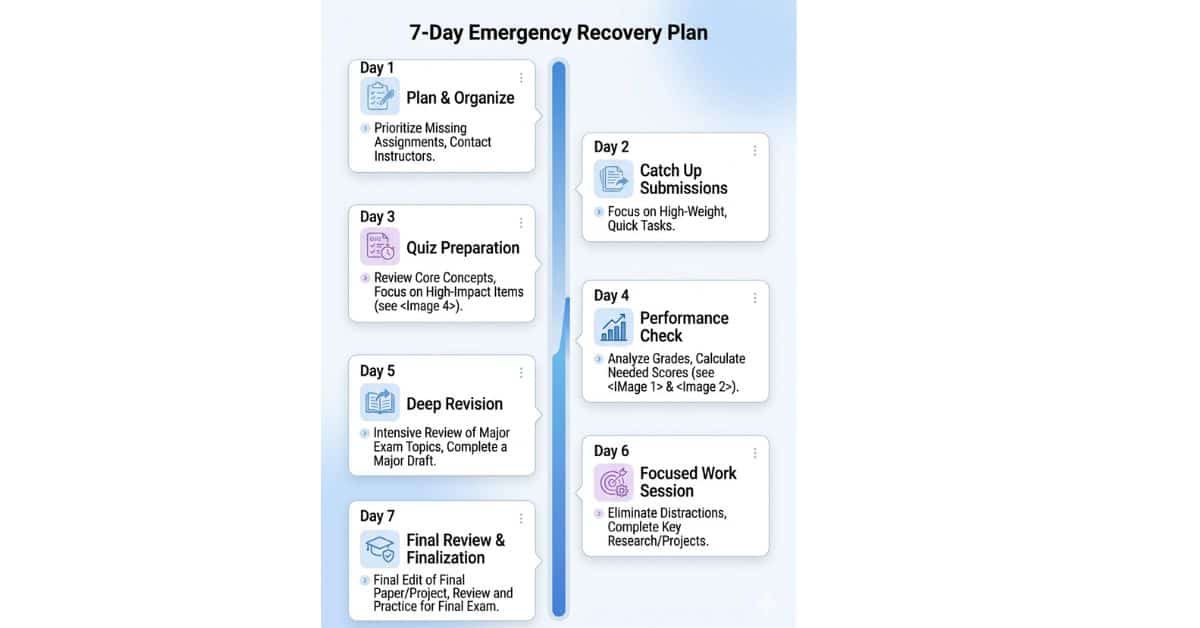
When your grade feels out of control inside Canvas LMS, the biggest mistake is trying to “study everything.” That approach fails under pressure.
This 7-day emergency plan is designed to maximize grade recovery in the shortest possible time by focusing only on high-impact actions.
 Day 1: Audit & Missing Work List (Reality Setup)
Goal: Understand exactly what is left
- Open the Canvas dashboard and list all missing assignments.
- Check upcoming deadlines
- Identify graded vs ungraded tasks.
- Separate high-weight vs low-weight items
Outcome:You stop guessing and create a clear recovery map
Day 2–3: High-Value Submissions (Fast Grade Boost)
Goal: Recover maximum points quickly
- Submit all missing major assignments.
- Focus on tasks with the highest percentage weight.
- Complete anything that gives instant grade improvement.
- Fix easy zero-score items first.
Outcome:Your grade stabilizes and improves immediately
Day 4–5: Quiz Focus Phase (Performance Recovery)
Goal: Improve medium-weight scores
- Attempt quizzes with revision
- Retake opportunities (if allowed)
- Focus on frequently tested topics.
- Improve weak areas based on past results.
Outcome:Your average performance starts increasing steadily.
Day 6: Revision & Weak Area Fixing
Goal: Strengthen final exam readiness
- Review weak topics only (not full syllabus panic study)
- Focus on high-weight exam concepts.
- Use past quizzes/assignments as a guide.
- Create quick revision notes.
Outcome:You shift from recovery mode to exam preparation mode.
Day 7: Final Check Strategy (Control Phase)
Goal: Lock your recovery plan
- Recalculate current grade status.
- Confirm the remaining required score for passing.
- Identify the final exam target score.
- Make a realistic “pass vs improve” decision.
Outcome:You now know exactly what result is achievable
Key Insight
Inside Canvas LMS, last-minute recovery is not about doing more—it is about doing the right actions in the right order under time pressure.
A structured 7-day plan is more powerful than weeks of random studying.
Grade Growth Strategy (Beyond Passing)
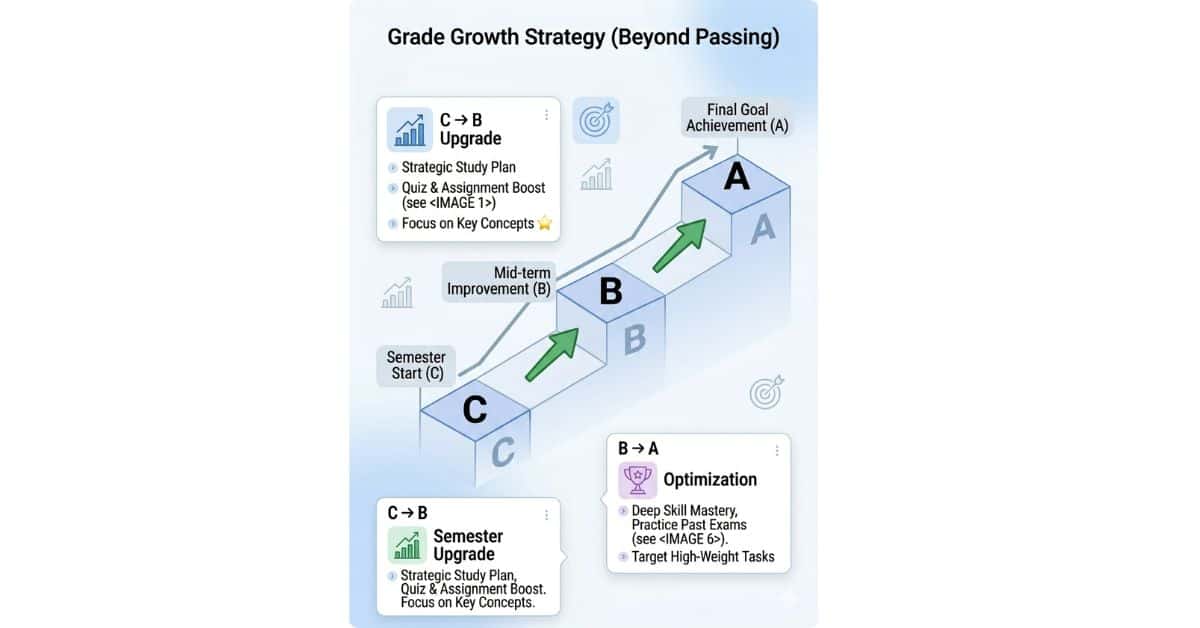
Once you are no longer in “failing recovery mode” inside Canvas LMS, the next level is grade growth optimization. This is where students stop thinking about survival and start strategically improving their academic standing.
Most students stop at passing—but high-performing students use the remaining course structure to upgrade their final grade.
C → B Upgrade Path (Stabilization to Strong Performance)
Goal: Move from passing to solid performance
If you are currently in a C range, your focus should be:
- Recover all remaining missing points.
- Improve quiz and assignment consistency.
- Avoid zero-score submissions
- Target steady mid-range performance, not perfection
What this means in real life:
A C grade usually means you are still inconsistent, not incapable. Small improvements in remaining tasks can push you into a stable B range.
Key idea: consistency beats intensity. B → A Optimization (High Performance Upgrade)
Goal: Shift from good to excellent grade
If you are already in B range, your strategy changes completely:
- Focus on high-weight assignments only.
- Improve exam performance significantly.
- Reduce small, careless mistakes.
- Maximize rubric-based scoring opportunities.
What this means in real life:
At this stage, small changes have a big impact. Even a few percentage improvements in weighted tasks can push your final grade into the A range.
Key idea: precision matters more than effort. Extra Credit Strategy (If Available)
Many courses inside Canvas LMS include optional opportunities that students ignore.
Common forms:
- Bonus assignments
- Participation marks
- Optional quizzes or discussions
- Instructor-added improvement tasks
Smart usage strategy:
- Only complete the extra credit after securing high-impact work.
- Do not replace core assignments with bonus tasks.
- Use it as a grade buffer, not a main strategy.
Important reality:
Extra credit does not fix poor performance—it only enhances already improving performance.
Key Insight
Grade growth is not random—it follows a structured progression:
- C → fix stability
- B → optimize performance
- A → refine precision.
Inside Canvas LMS, students who understand this shift stop struggling and start controlling outcomes.
Final Action Checklist (PRINTABLE STYLE)
This is your execution checkpoint inside Canvas LMS. If you’ve gone through the full strategy above, this section helps you confirm whether you are actually ready to improve your grade or still missing critical steps.
Most students read strategies but fail to execute them. This checklist removes guesswork and forces clarity.
Grade Recovery Execution Checklist
Before you move forward, make sure every item below is completed:
I have checked all the missing work and submitted what is recoverable.
I understand how my grade is calculated (weighted system clarity)
I know what my final exam impact is on the total grade.
I have calculated the minimum score needed to pass.
I have prioritized high-impact assignments over low-value tasks.
What this checklist means in real life
If all boxes are checked:
You are no longer a “confused student.” You are now in active recovery or optimization mode Your grade outcome is based on execution, not guesswork anymoreIf even 1–2 boxes are unchecked:
You still don’t fully understand your situation You are likely wasting effort on low-impact work Your recovery strategy is not fully active yet Final Reality Reminder
Inside Canvas LMS, students don’t fail because they don’t try hard enough—they fail because they skip structured execution steps.
This checklist is your final “control point” before results change.
Use this tool to calculate your current grade and understand exactly what score you need to pass or improve.
Conclusion
At this point, you already understand how your grade works, what your risk level is, and what actions actually improve your result inside Canvas LMS.
The only thing left is execution.
Most students stay stuck because they keep checking grades again and again instead of following a structured plan. But real improvement starts when you stop guessing and start acting with strategy.
 Final Message
“Stop guessing your grade — start controlling it with strategy.”
Take Your Next Step
Choose what you need right now:
- Check My Grade Plan → Understand exactly where you stand
- Calculate My Passing Score → Find the exact score needed to pass
- Build My Recovery Strategy → Get a step-by-step action plan
Inside Canvas LMS, success is not about working harder—it’s about working on the right things in the right order.
Your grade doesn’t improve by thinking about it. It improves by acting on it.