
Table of Contents
Introduction
Have you ever switched to another browser tab during a Canvas quiz and wondered if your professor noticed?
If you’re new to Canvas, this question can feel confusing, especially during an important quiz. Many students assume Canvas can automatically see everything happening on their computer. That is not always the case.
So, can Canvas see if you switch tabs? The answer depends on how your quiz, browser, and school’s monitoring tools are configured. Standard Canvas features and additional proctoring tools can work very differently.
In this guide, we’ll explain what Canvas can actually detect when you switch tabs. You’ll learn how Canvas handles quiz activity, other browser tabs, and split-screen use. We’ll also explain what professors may see in Canvas activity records.
By the end, you’ll understand the difference between Canvas tracking activity and full device monitoring. You’ll also know when extra tools, such as lockdown browsers or proctoring software, may change what gets monitored.
Can Canvas See If You Switch Tabs?
Can Canvas see if you switch tabs? Not in the same way a monitoring app can watch your entire screen. Standard Canvas does not generally give instructors a view of your other browser tabs or their contents. However, Canvas may record certain activity related to a quiz or course page when you leave or return to it.
When you leave a Canvas page, your browser simply moves your focus to another tab or window. Canvas cannot normally read the website you opened there. So, can Canvas see your tabs? It generally cannot see the contents of other tabs or know exactly what you are viewing.
There’s an important difference between detecting an interaction with Canvas and seeing another tab. Canvas may record events related to your Canvas session, depending on the feature and quiz setup. That information does not automatically show your professor what you did elsewhere.
Switching tabs is only one part of Canvas activity tracking, so you may also want to read what professors can see on Canvas during courses, quizzes, and assignments.
What Canvas Activity Logs Really Mean
Canvas activity logs can provide useful information about quiz or course activity. However, an activity record does not automatically prove that a student cheated. A student might leave a quiz because of a technical issue, notification, or accidental tap.
This means can Canvas see when you switch tabs and can Canvas see what tabs you have open are different questions. Your school may also use separate proctoring or lockdown software with additional monitoring abilities.
Pro Tip: Always check your quiz instructions before starting. Look for requirements involving lockdown browsers, screen monitoring, webcams, or other proctoring tools.
Does Canvas Track Tab Switching?
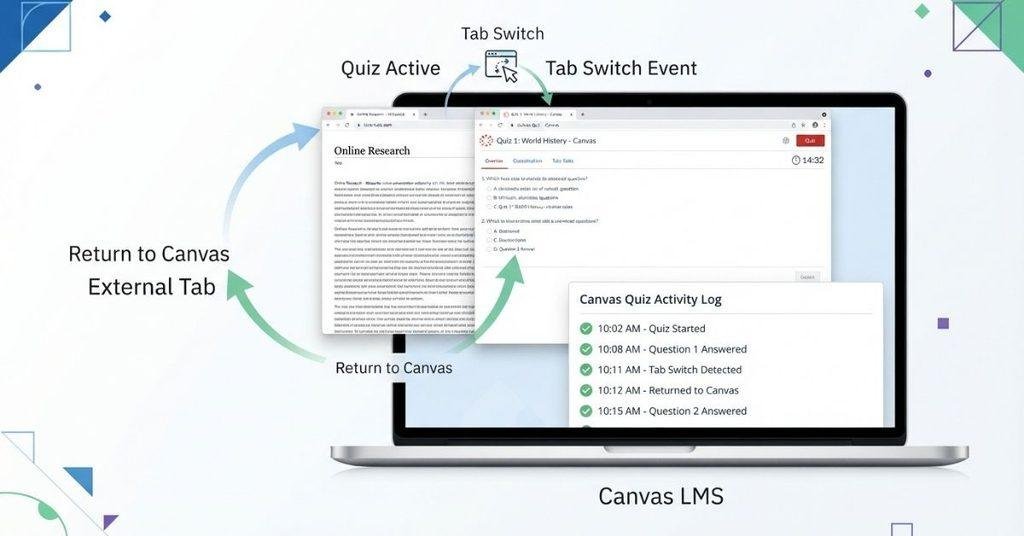
Does Canvas track tabs? Standard Canvas does not normally monitor the contents of unrelated browser tabs. It also does not work like screen-recording software that watches everything you do on your device.
Instead, Canvas can record certain actions that happen within Canvas itself. For example, a quiz may generate activity records connected to your session. These records can help show what happened inside Canvas, but they do not necessarily reveal what you viewed elsewhere.
Tracking Tabs vs. Recording Canvas Activity
There’s a key difference between tracking your tabs and recording activity within Canvas. If you switch from Canvas to another website, Canvas does not normally gain access to that website’s page or content.
However, quiz settings can affect what activity gets recorded. Your school may also use additional tools that provide monitoring features beyond standard Canvas.
So, can Canvas track tabs or does Canvas track when you switch tabs? The answer depends on the specific Canvas feature and monitoring setup. An instructor’s available information can vary based on how the course and quiz are configured.
Pro Tip: Check your quiz instructions before starting. They should explain any required monitoring software or browser restrictions.
Can Canvas Detect When You Switch Tabs During a Quiz?
Does Canvas quiz track tabs? Canvas can record certain quiz activity, but that does not mean it sees everything you do in another tab. What gets recorded depends on the Canvas quiz features and any additional monitoring tools your school uses.
When you leave a Canvas quiz, your browser moves away from the quiz page. Canvas may record quiz-related events associated with your session. However, a recorded event does not automatically reveal what you viewed or did in another browser tab.
What Can a Canvas Quiz Log Establish?
A quiz log can provide information about activity connected to a quiz. It may help instructors understand when certain quiz interactions occurred. However, students should not treat every recorded event as proof of misconduct.
So, can Canvas detect switching tabs? You should not assume that every tab switch appears as a clear, visible alert to your professor. Likewise, does Canvas know if you switch tabs does not necessarily mean Canvas knows what you did there.
The same applies to does Canvas show when you switch tabs. Available information depends on the Canvas setup, quiz configuration, and any third-party monitoring tools involved. A tab-related event alone cannot establish why you left the quiz or what you did afterward.
Can Canvas See Other Tabs You Have Open?
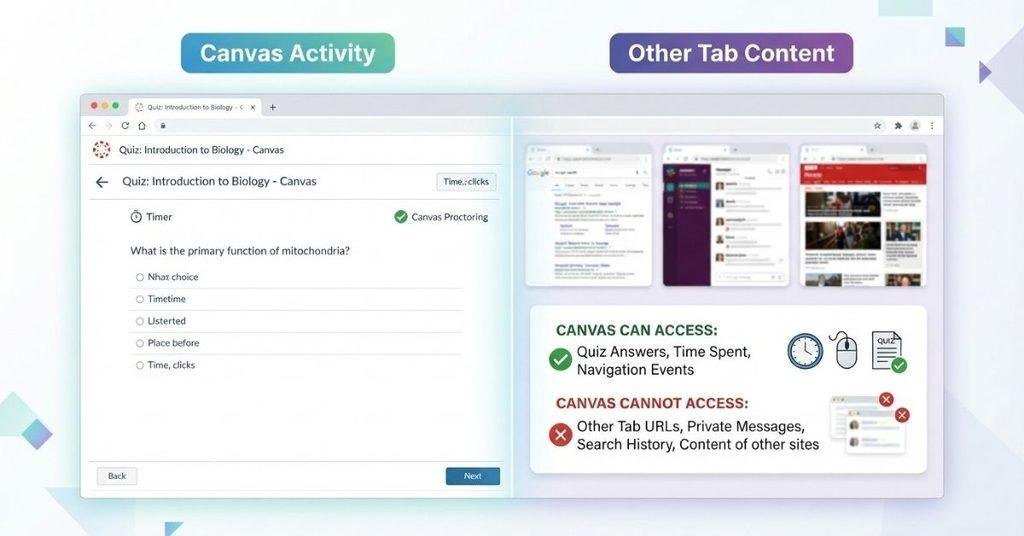
Can Canvas see other tabs? Standard Canvas generally cannot view the contents of unrelated browser tabs. It does not normally give instructors direct access to everything you open outside Canvas.
For example, Canvas generally cannot see your Google searches, read messages in another tab, or view the page content of another website. It also does not normally show your professor a complete list of every tab currently open on your device.
What Canvas May Record
Canvas can record certain activity that happens within its own environment. Depending on the feature, this may include quiz-related events, page interactions, or other course activity.
That creates an important distinction. Can Canvas see your tabs is different from whether Canvas records an event connected to your Canvas session. A recorded Canvas event does not automatically reveal the content of another website.
Similarly, can Canvas see what tabs you have open does not mean Canvas can see everything happening on your device. Your school’s setup can also include additional monitoring tools with different capabilities.
If you are taking a monitored quiz, learn more about whether Canvas records your screen and what screen monitoring may involve.
Can Canvas Detect Split Screen?
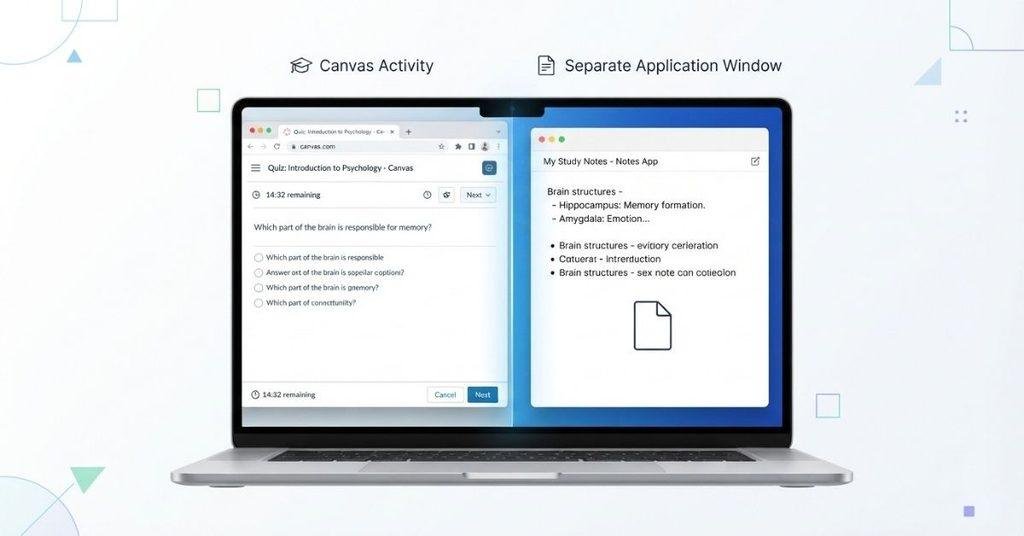
Can Canvas detect split screen? Standard Canvas generally cannot directly see the other application or window beside your Canvas page. Split screen simply lets you display two apps or windows at the same time.
For example, you might place a Canvas quiz beside a document or another allowed resource. Canvas does not normally receive the contents of that second window. However, your device and browser can handle focus changes differently.
Using split screen is also different from completely leaving a Canvas quiz. When you switch focus between windows, Canvas may record certain quiz or page activity, depending on the feature being used. That record does not automatically show what appears in the other window.
What Students Should Know About Split Screen
So, can Canvas tell when I have a split screen? You should not assume that standard Canvas can directly view your entire screen or identify the second application. However, additional monitoring software may have broader capabilities.
Your browser, device, quiz settings, and school-required tools can all affect what gets recorded. Always follow the specific rules provided with your quiz.
Can Canvas Tell If You Switch to Another Tab for Less Than 30 Seconds?
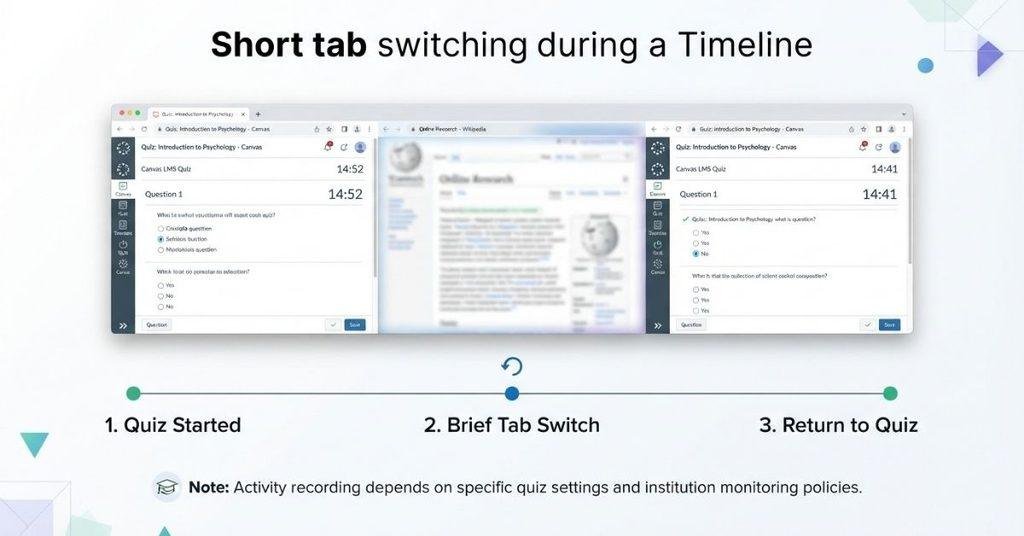
Can Canvas tell if you switch to a different tab for less than 30 seconds? There is no universal 30-second rule that makes a tab switch invisible to Canvas. Short visits to another tab can still affect quiz or browser activity, depending on the setup.
Canvas features can handle quiz activity in different ways. A brief switch away from a quiz may create an activity event, or the available information may not clearly identify what happened outside Canvas. The exact behavior depends on the quiz configuration and any additional monitoring tools.
Students should not assume that staying away for only a few seconds prevents activity from being recorded. Likewise, a possible activity record does not automatically show what you viewed in another tab or prove that you cheated.
The safest approach is to follow your instructor’s quiz rules. If outside tabs aren’t allowed, avoid switching away from the quiz, regardless of how short the switch might be.
Does Canvas Know When You Switch Tabs on Your Phone?
Using Canvas on a phone can work differently from using it on a desktop or laptop. The Canvas Student app and a mobile browser also handle quizzes and page activity differently.
If you leave the Canvas Student app or switch to another mobile app, Canvas does not normally gain access to that app’s contents. However, certain Canvas activity may still be recorded while you use a quiz or course feature. The exact behavior depends on the Canvas feature and your school’s setup.
Mobile devices also manage apps, browser tabs, and screen focus differently from computers. Because of this, you shouldn’t assume desktop and phone behavior will always match.
If your instructor requires a specific device, browser, or monitoring tool, follow those instructions carefully. Some third-party monitoring solutions may have capabilities beyond standard Canvas.
Pro Tip: Before starting a mobile quiz, check whether your instructor allows phones. If a specific browser or app is required, use the recommended option.
What Can Professors Actually See on Canvas?
Professors can see different types of information through Canvas, depending on their course permissions and the features they use. This can include quiz activity, submissions, grades, course activity, and discussion participation.
For quizzes, instructors may have access to available quiz logs or other activity information. These records can provide context about quiz interactions, but they don’t automatically expose everything happening on your device.
Canvas also doesn’t automatically give professors access to unrelated browser tabs, private messages, or the contents of other websites. Additional monitoring tools can provide different capabilities.
Does Switching Tabs Mean Canvas Detects Cheating?
Does Canvas detect cheating just because you switch tabs? Not necessarily. A tab switch or quiz activity event does not automatically prove that a student cheated.
Canvas activity data needs context. A student might leave a quiz because of a technical problem, an accidental tap, or another unexpected interruption. An activity record may show that something happened, but it may not explain why it happened or what the student viewed elsewhere.
So, how does Canvas detect cheating? Standard Canvas does not simply label every tab switch as cheating. Instructors may review available quiz activity alongside submissions, course activity, and other information when concerns arise.
Different schools can also use different monitoring tools. Proctoring software or lockdown browsers may monitor additional device activity beyond standard Canvas features.
What About Canvas Proctoring and Lockdown Browsers?
Standard Canvas and Canvas with additional monitoring tools are not the same. A regular Canvas quiz may provide course and quiz activity information. Third-party proctoring or lockdown software can add more controls and monitoring features.
Depending on the tool and your school’s settings, additional software may provide features such as:
- Browser restrictions that limit which websites or tabs you can access.
- Webcam monitoring during a proctored assessment.
- Screen monitoring that can capture or review screen activity.
- Identity verification to confirm the test-taker’s identity.
- Restricted navigation that prevents certain actions during a quiz.
These capabilities don’t come from every Canvas quiz automatically. Your institution must enable and configure the relevant tools, and requirements can vary between courses.
For more detail, see our guides on Does Canvas Have a Lockdown Browser?, Does Canvas Record Your Screen?, and Does Canvas Have AI Detection? Each guide explains these features separately without confusing them with standard Canvas activity tracking.
How Can Students Check Whether a Canvas Quiz Uses Extra Monitoring?
Before starting a Canvas quiz, check the instructions for any extra monitoring requirements. Your instructor or school should provide details if the assessment requires special software or device settings.
Look for mentions of a lockdown browser, proctoring service, webcam, microphone, or required browser. You may also find these requirements in instructor announcements, course modules, assignment details, or quiz instructions.
Pay attention to requirements such as:
- Quiz instructions: Check for specific testing rules or software requirements.
- Instructor announcements: Look for reminders about upcoming proctored assessments.
- Required browser or software: Note whether you must install or use a specific application.
- Lockdown browser: Check whether the quiz requires restricted browsing.
- Proctoring instructions: Review setup steps before the test begins.
- Webcam or microphone: Confirm whether your device needs these features enabled.
If you’re unsure, ask your instructor before taking the quiz. Don’t rely on assumptions about what Canvas can or cannot monitor.
Pro Tip: Complete any required system checks before test day. This can help prevent technical problems during your assessment.
Canvas Tab Switching — Desktop vs. Mobile
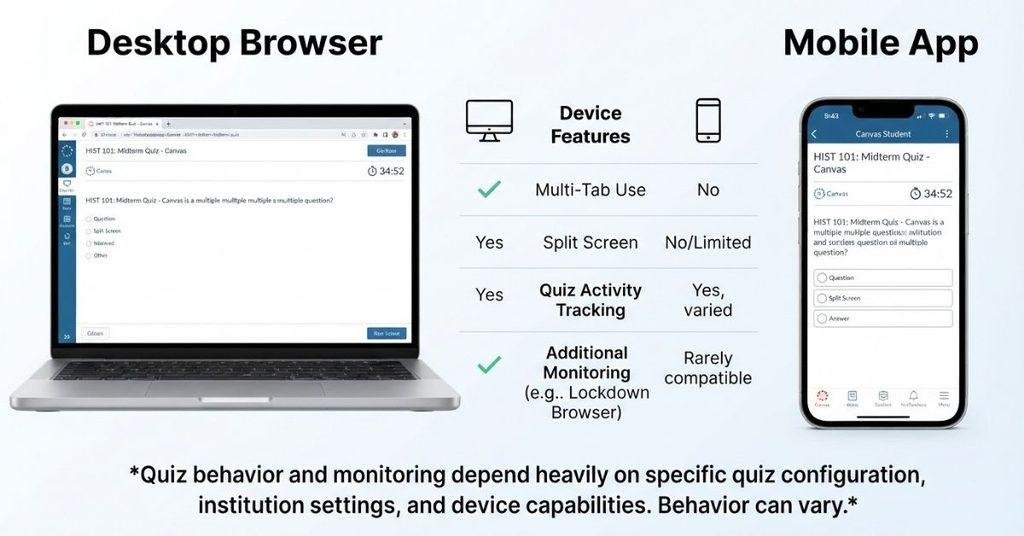
Canvas can behave differently across devices, browsers, and apps. The key factor is your quiz setup and whether your school uses additional monitoring tools.
| Situation | What students should know |
|---|---|
| Canvas in a normal browser | Canvas activity is primarily related to actions within Canvas. |
| Switching to another browser tab | Leaving a quiz may affect recorded activity, depending on the setup. |
| Split-screen | Behavior can vary based on your device, browser, and quiz configuration. |
| Canvas Student app | Mobile quiz behavior can differ from desktop browser behavior. |
| Lockdown or proctoring software | Additional tools may restrict navigation or provide broader monitoring capabilities. |
The table shows why there’s no single rule for every Canvas quiz. Standard Canvas features, mobile apps, browsers, and third-party tools can handle activity differently.
If your instructor provides specific device or browser requirements, follow those instructions. They take priority over assumptions about how Canvas works.
Pro Tip: Test the required Canvas setup before an important quiz. This helps you identify browser, app, or software requirements early.
If you know your current Canvas percentage and upcoming quiz weight, the Canvas Grade Calculator can help you test different possible scores.
Conclusion
So, can Canvas see if you switch tabs? Standard Canvas generally focuses on activity within Canvas, not the contents of unrelated tabs. Quiz settings, device behavior, and additional monitoring tools can change what gets recorded.
A tab switch does not automatically prove cheating. Canvas activity logs need context, and instructors may see different information based on their course setup. Proctoring software or lockdown browsers can also provide additional monitoring features.
If you’re taking a Canvas quiz, check the instructions before you begin. Follow any browser, device, webcam, or proctoring requirements provided by your instructor.
Have questions about Canvas monitoring? Share your experience in the comments. You can also explore our other Canvas guides for more helpful student tips.
Frequently Asked Questions
Standard Canvas generally cannot see the contents of another browser tab. However, certain quiz or page activity may be recorded when you leave or return to Canvas. Your course setup and monitoring tools can affect what information becomes available.
Canvas generally does not show instructors a complete list of your open browser tabs. It also does not normally expose the contents of unrelated websites. Additional proctoring software may have broader monitoring capabilities.
Canvas can record certain quiz-related activity, but that does not mean it monitors every tab on your device. Quiz settings and additional monitoring tools can affect what gets recorded.
Standard Canvas generally cannot directly view the other window in a split-screen setup. However, device behavior and third-party monitoring software can change what gets detected or restricted.
There is no universal 30-second rule. A short tab switch may still affect recorded activity, depending on your quiz and monitoring setup. Do not assume a brief switch stays invisible.
Professors generally cannot view the contents of your unrelated browser tabs through standard Canvas. They may access Canvas-related activity and quiz information available through their course setup.
Canvas may record certain activity associated with leaving or returning to a quiz. However, this does not necessarily mean Canvas knows what you viewed in another tab.
No. A tab switch alone does not automatically prove cheating. Instructors need to consider the available activity data and surrounding context. Additional proctoring tools may provide more information.

We are the Canvas Academic Team, a developer team focused on building simple and practical tools that help students succeed academically. This platform was created specifically for Canvas LMS students to make grade tracking, GPA calculations, exam planning, and academic management easier and more efficient.
Our focus is on creating fast, accurate, and student-friendly educational tools along with helpful learning resources that improve productivity and reduce academic stress.
Through CanvasGradeCalculator.com, our goal is to continue building useful resources that help students study smarter, stay organized, and achieve better academic results.