
Table of Contents
Introduction
Wondering how likely you are to get into your dream college?
Learning how to calculate chances of getting into a college can make the admissions process easier to understand. Many students compare their GPA, test scores, activities, and other academic details with typical college requirements.
However, college admission is not based on one simple formula. Schools consider many factors, and admission standards can change each year. Your estimated chances should guide your planning, not guarantee an admission decision.
In this guide, you will learn how college acceptance chances are estimated. We will cover the key factors that can affect your results and explain a simple approach beginners can follow.
You will also see how a college chances calculator can provide a personalized estimate. This can help you understand where you may stand before applying.
By the end, you will have a clearer way to evaluate your college options and plan your applications with more confidence.
What Does It Mean to Calculate Your College Chances?
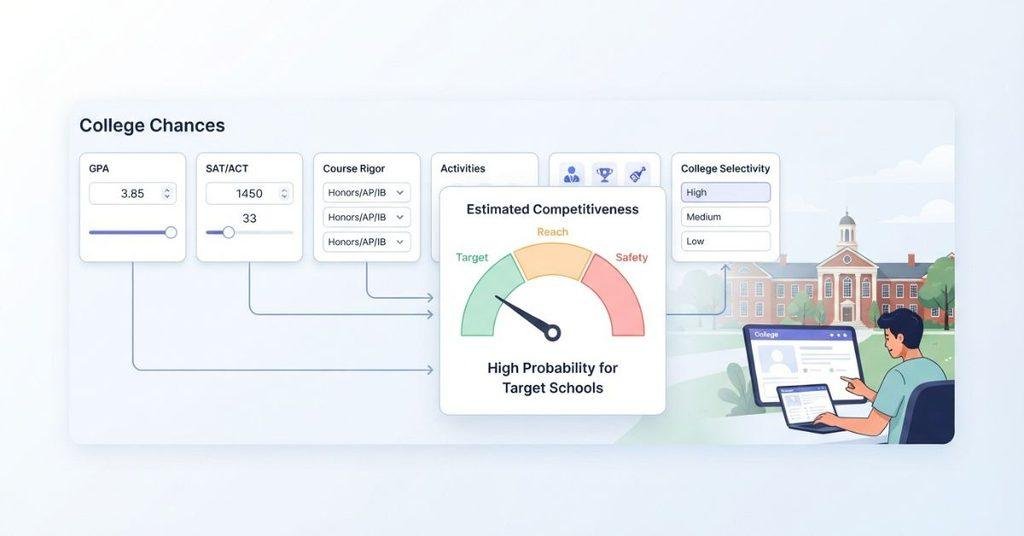
Calculating your college chances means estimating how well your application matches a college’s typical admission profile. The estimate may consider factors such as GPA, test scores, course rigor, activities, and other application details.
A college acceptance chances estimate is not the same as an admission prediction. An estimate helps you understand your position based on available information. It cannot tell you whether a college will accept or reject your application.
The same student can also have different chances at different colleges. Each school has its own applicant pool, admission standards, academic programs, and selection process. A GPA or test score may be competitive at one college but less competitive at another.
That’s why college-specific data matters when you calculate college chances. Looking at the right school’s admission information gives you a more useful estimate. You should use these results as one planning tool alongside the college’s official requirements and application guidance.
Pro Tip
Compare your academic profile with data from each specific college. Avoid using one general estimate for every school.
What Factors Affect Your Chances of Getting Into College?
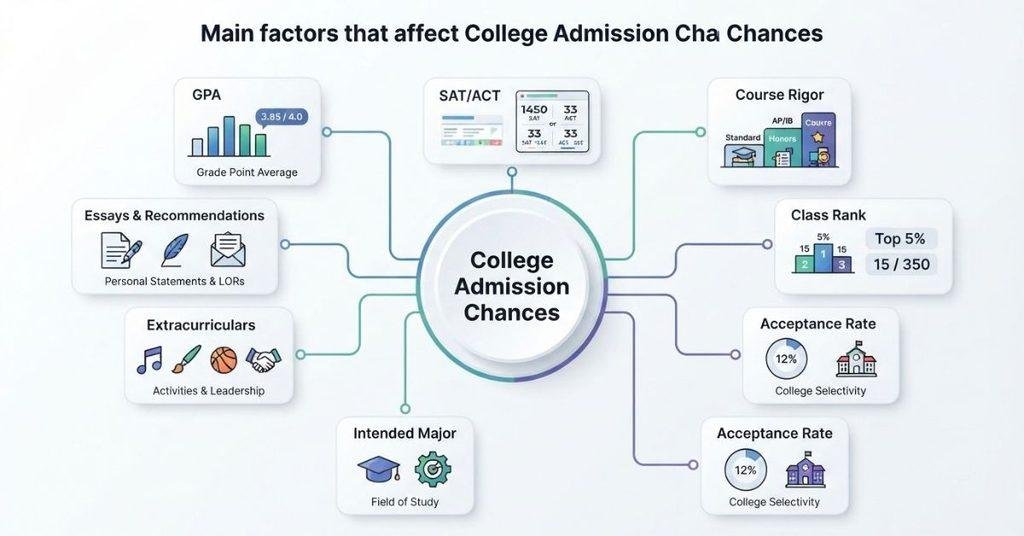
Your college admission chances depend on more than one number. Colleges review different parts of your application to understand your academic preparation, interests, achievements, and overall fit.
The importance of each factor can also vary by college. Some schools use a holistic review process, while others place more weight on academic measures. Check each college’s official admissions information before estimating your chances.
GPA
Your GPA shows your overall academic performance across your courses. When you calculate college chances, look at both your GPA and the grading scale your school uses.
A 3.7 GPA can mean something different on a 4.0 scale than on another scale. Colleges may also consider weighted and unweighted GPAs differently.
Your GPA becomes more useful when you compare it with the academic profile of students a college typically admits. Still, GPA alone cannot determine an admission decision.
SAT and ACT Scores
SAT and ACT scores may be part of the application process, depending on the college and its current testing policy. If scores are considered, review the college’s published score ranges.
Some colleges use test-optional policies, while others have different testing requirements. Always check the current policy directly with the college.
Test scores should not be treated as the only measure of your admission chances. Colleges may consider grades, coursework, activities, essays, and other application factors.
Course Rigor
The difficulty of your courses can provide context for your academic record. Colleges may consider advanced coursework such as AP, IB, Honors, and other advanced classes.
Taking challenging courses can show that you pursued academic opportunities available at your school. However, course selection should reflect your preparation and your school’s offerings.
Colleges can also consider your academic strength relative to the courses available to you. A student at one school may have different course options than a student at another school.
Class Rank and Academic Standing
Class rank shows where you stand academically compared with other students in your graduating class. For example, being in the top 10% means you rank among the highest-performing students in your class.
Some schools report class rank or percentile, while others do not. Colleges may also consider your school’s academic context when reviewing your record.
If your school does not calculate class rank, you can still use your GPA and other academic information when estimating your college chances.
College Acceptance Rate
A college’s acceptance rate shows the percentage of applicants admitted during a particular admission cycle. It can provide useful context about a school’s overall selectivity.
However, acceptance rate alone cannot determine your personal admission chances. It does not account for your GPA, coursework, test scores, activities, intended major, or other application details.
Use acceptance rate as background information rather than treating it as your individual probability of admission.
Intended Major
Your intended major can matter at some colleges, especially when certain programs have separate admission processes or limited capacity.
Some academic programs may receive more applications than available spaces. Requirements can also differ between a college and specific schools, departments, or programs.
Check whether your intended major has separate admission requirements before estimating your chances.
Extracurricular Activities
Extracurricular activities can help colleges understand your interests and involvement outside the classroom. Examples include clubs, sports, volunteering, work, community activities, and leadership roles.
Colleges may consider your achievements, responsibilities, and the depth of your involvement. A smaller number of meaningful activities can provide more context than simply listing many activities.
Your opportunities also depend on what your school and community make available. Colleges may consider that context when reviewing your application.
Essays, Recommendations, and Other Factors
Essays and recommendations can provide information that grades and test scores cannot show. They can explain your interests, experiences, goals, and personal perspective.
Colleges may also consider application quality and institutional priorities. These can include factors related to the college’s current academic or enrollment needs.
Because admissions practices differ, no calculator can capture every part of an application. Use your estimate as a planning tool, then review each college’s official admissions information for its current requirements and policies.
How to Calculate Your Chances of Getting Into College
If you want to calculate your chances of getting into a college, start with your own academic profile. Then compare it with information from the specific college you want to attend.
Step 1 — Gather Your Academic Information
Start by collecting your current academic information. This gives you a clear picture of your academic profile.
Include:
- Overall GPA
- GPA scale
- Class rank, if available
- AP, IB, Honors, and other advanced courses
- Your overall academic performance
Make sure you use the correct GPA scale when comparing your record with college information.
Step 2 — Gather Your Test Scores
Next, collect your SAT or ACT scores if you have them. If you have not taken either test, note whether you are applying under a test-optional policy.
Check the college’s current testing policy before using scores in your estimate. Policies can vary between colleges and may change over time.
Step 3 — Choose the College
Choose the specific college you want to evaluate. Avoid using general national admission data for a college-specific estimate.
Review the school’s official admissions information. Look for published GPA information, SAT or ACT ranges, acceptance data, and other relevant academic details.
Step 4 — Compare Your Profile With the College
Compare your profile with the college’s available admission information. Focus on the factors that the school reports or considers.
Compare your:
- GPA
- SAT or ACT scores
- Course rigor
- Class rank, if available
- Other relevant academic factors
Remember that published ranges describe past or current applicant data. They do not guarantee how a college will evaluate your application.
Step 5 — Consider College Selectivity
Look at the college’s acceptance rate and overall selectivity. Also consider the size and competitiveness of its applicant pool.
Your intended program can matter too. Some programs may have additional requirements or limited capacity.
Acceptance rate alone cannot tell you your personal admission chances. Use it as one part of the overall picture.
Step 6 — Consider the Rest of Your Application
Academic information is only part of many college applications. Consider other parts of your application, including:
- Extracurricular activities
- Leadership
- Essays
- Recommendations
- Awards and achievements
- Work or community involvement
These factors can provide additional context about your interests, experiences, and accomplishments.
Step 7 — Estimate Your Competitiveness
After reviewing the information, estimate how your profile compares with the college.
You can use these planning categories:
- Safety: Your academic profile appears stronger than the college’s typical admitted profile.
- Target: Your profile appears reasonably aligned with the college’s typical admitted profile.
- Reach: Your profile falls below some typical admission measures, or admission remains uncertain.
- Highly Competitive: The college has especially selective admissions, making outcomes difficult to estimate.
These categories are planning tools, not guarantees. Even a strong academic profile cannot ensure admission.
Step 8 — Use a College Chances Calculator
A college chances calculator can make this process easier. Instead of comparing each factor manually, you can enter the relevant information and receive an estimated competitiveness result.
Our calculator is designed to help students combine important academic and college-specific inputs into one simple estimate. Use the result to support your college planning, not as a guaranteed admission prediction.
How Is a College Chances Estimate Calculated?
A college chances estimate combines several pieces of information to show how competitive your profile may be. The exact method can differ between calculators, and colleges use their own admission processes.
A trustworthy estimate should not rely on an unsupported formula or promise a specific admission outcome. Instead, it can organize relevant student and college information into a useful planning estimate.
Academic Profile
Your academic profile usually starts with your GPA and overall academic performance. Your coursework also adds important context to your grades.
Advanced classes, such as AP, IB, and Honors courses, can show the level of academic challenge available to you. Your school’s course offerings also provide context for evaluating your academic record.
Test Score Profile
If you submit test scores, your SAT or ACT results can add another academic measure. Comparing your score with the college’s published ranges provides useful context.
However, not every college requires or considers test scores in the same way. Always check the college’s current testing policy before using scores in an estimate.
College Selectivity
College selectivity provides important context for your estimate. Factors can include the school’s acceptance rate and the academic profile of its applicants.
A highly selective college may receive many applications from students with strong academic records. Therefore, meeting a published score range does not guarantee admission.
Additional Applicant Factors
Other application factors can also affect your overall competitiveness. Depending on the college, these may include your intended major, extracurricular activities, essays, recommendations, and achievements.
These factors can add context that GPA and test scores cannot capture by themselves. Their importance varies by college and admission process.
Overall Competitiveness
A useful estimate considers multiple factors together instead of relying on one number. Your academic profile, test scores, college selectivity, and other application details can provide a broader picture.
The result should help you plan your college list and applications. It should not be treated as a guaranteed admission prediction.
How to Calculate College Chances From GPA and SAT/ACT
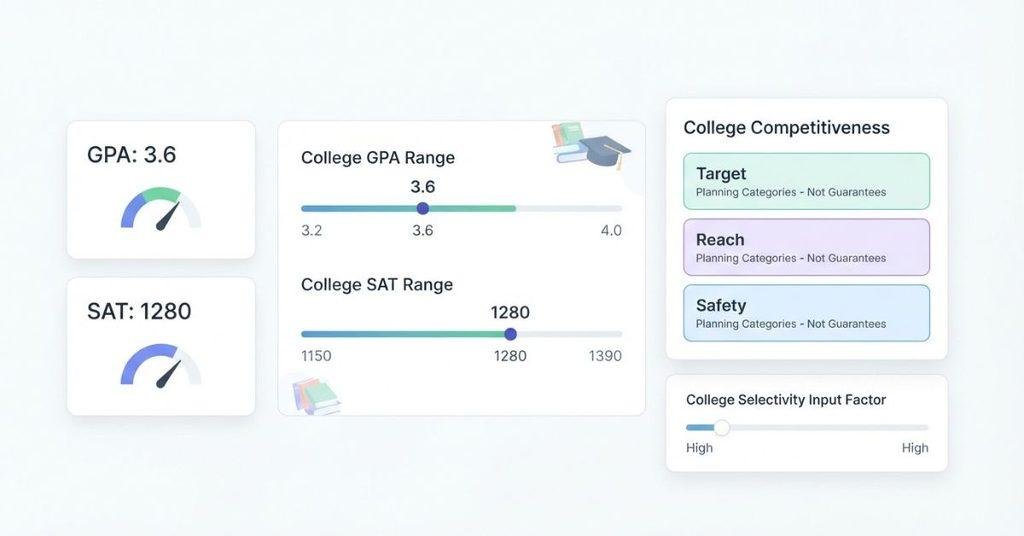
GPA and SAT/ACT scores are two common academic measures students use when estimating college chances. Comparing them with college-specific information can help you understand your academic competitiveness.
Start With Your GPA
Begin with your current GPA and confirm the scale your school uses. Then compare your GPA with the college’s published academic information, when available.
Look for information about the typical GPA or academic profile of admitted students. A closer match can provide useful context, but GPA alone cannot determine admission.
Compare Your SAT or ACT Score
Next, compare your SAT or ACT score with the college’s published score range. Check whether the college reports scores for admitted or enrolled students.
Your position within that range can provide additional context. Remember that some colleges are test-optional or use different testing policies.
Consider Both Together
GPA and test scores can provide more context when considered together. A strong GPA can show consistent academic performance, while test scores can provide another standardized academic measure.
Neither metric tells the complete story. Coursework, school context, activities, essays, and other application factors can also matter.
Add College Selectivity
Finally, consider the college’s overall selectivity. The same GPA and SAT score can represent different levels of competitiveness at different colleges.
For example, a profile that compares well with one college’s academic range may compare differently with another school’s applicant pool. That is why college-specific data is essential when you calculate college chances.
Can You Calculate Your Chances of Getting Into a Specific College?
Yes, you can estimate your chances for a specific college by comparing your profile with that school’s admission information. College-specific estimates are usually more useful than one general college acceptance estimate.
Each college can have different admission standards, acceptance rates, and applicant profiles. A GPA and test score combination may be competitive at one school but less competitive at another.
Your intended major can also affect the comparison. Some colleges have separate admission processes or more competitive programs with additional requirements.
When you calculate chances of getting into a certain college, use current information from that college whenever possible. Review its official admissions requirements, testing policy, academic information, and program details.
A calculator can then help organize these factors into an estimate for that specific school. Use the result as a planning tool rather than a guaranteed admission outcome.
Calculate Your Chances at a Specific College
What Is a Good College Acceptance Chance?
There isn’t one universal percentage that guarantees college admission. Admissions decisions depend on the college, applicant pool, program, application strength, and other factors.
Instead of focusing only on a percentage, use competitiveness categories to organize your college list.
Safety
A safety school is one where your academic profile appears stronger than the college’s typical admitted profile. However, no college should be treated as guaranteed admission.
Strongly Competitive Profile
Your profile compares favorably with the college’s available academic information. Other application factors can still affect the final decision.
Target
A target college appears to be a reasonable academic match based on the information available. Admission remains uncertain because colleges review applications differently.
Reach
Admission is possible, but the outcome is less predictable. Your profile may fall below some typical academic measures, or the college may have highly selective admissions.
Highly Competitive
Your profile may fall significantly below the college’s typical competitiveness, or the institution may be extremely selective. Meeting minimum requirements does not necessarily make admission likely.
These categories are more useful for planning than arbitrary percentage thresholds. A college chances calculator can help you compare your profile with each school while keeping the estimate in context.
How Accurate Are College Chances Calculators?
College chances calculators can provide a useful estimate, but they cannot guarantee an admission decision. Colleges evaluate applications using their own requirements, policies, and review processes.
The quality of an estimate also depends on the data behind it. Current, college-specific information can provide more useful context than outdated or general admission data.
Applicant pools can change from one admission cycle to another. Test-optional policies can also change how students submit and how colleges use SAT or ACT scores.
Major-specific differences may matter when colleges have separate programs or admission requirements. Holistic admissions can also consider essays, activities, recommendations, achievements, and other factors that a calculator may not fully capture.
Key takeaway: Treat a college chances calculator as a planning tool, not an admissions decision. Use your estimate alongside the college’s current official admissions information.
How to Improve Your College Admission Chances
You can strengthen several parts of your application before applying. Focus on improvements that fit your academic goals, available opportunities, and application timeline.
Improve Your GPA
Focus on consistent academic performance in your current and future courses. Review difficult subjects early and use available academic support when needed.
A stronger GPA can improve your academic profile, but avoid sacrificing your well-being to chase a specific number.
Take Challenging Courses
Choose challenging courses that match your preparation and your school’s available options. AP, IB, Honors, and other advanced courses can demonstrate academic ambition.
Don’t take advanced classes simply for appearance. Choose coursework where you can maintain strong academic performance.
Strengthen SAT/ACT Scores When Relevant
If a college considers SAT or ACT scores, prepare carefully and give yourself enough time to improve. Review the college’s current testing policy before deciding whether to submit scores.
Focus on meaningful score improvement rather than treating one test result as the entire application.
Build Meaningful Extracurriculars
Choose activities that genuinely interest you and allow you to contribute over time. Leadership, achievements, work, volunteering, and community involvement can add useful context.
Depth can be more informative than collecting a long list of unrelated activities. Explain what you contributed and accomplished.
Strengthen Your Essays
Use your essays to provide context that your academic record cannot show. Write clearly about your experiences, interests, goals, and personal perspective.
Proofread carefully and make sure your responses directly address each college’s prompts.
Build a Balanced College List
Create a college list with different levels of admission competitiveness. Include schools where your profile appears to be a reasonable match, along with more competitive options.
Avoid building your entire list around highly selective colleges. A balanced list gives you more options during the application process.
Apply Strategically
Research each college’s deadlines, requirements, testing policies, and application options before applying. Submit complete applications and follow each school’s instructions carefully.
Use your college chances estimate to support your planning. Then verify important requirements through the college’s official admissions website.
Build a Balanced College List Using Your Chances
A balanced college list includes schools with different levels of admission competitiveness. The Safety, Target, and Reach approach can help you avoid relying on one type of college.
Use your academic profile, college-specific information, and estimated competitiveness when building your list. No category guarantees admission, so keep your options broad.
Safety Schools
Safety schools are colleges where your academic profile appears stronger than the school’s typical admitted profile. You should still review requirements and admission policies carefully.
Don’t assume any college is guaranteed. Admission decisions can include factors that a calculator cannot measure.
Target Schools
Target schools are colleges where your profile appears reasonably aligned with typical academic information. Your GPA, test scores, and coursework may compare well with the available data.
However, admission remains uncertain. Other applicants and application factors can affect the final decision.
Reach Schools
Reach schools are colleges where admission may be more difficult to predict. Your academic profile may fall below some typical measures, or the college may have highly selective admissions.
A reach school can still be worth considering if it fits your goals. Just avoid making your entire college list depend on reach schools.
Calculate Your Chances for Multiple Colleges
College Chances Calculator
Want a simpler way to compare your college options? Our college chances calculator combines the information you provide into an easy-to-understand estimate.
Enter your:
- GPA and GPA scale
- SAT or ACT score, when applicable
- Specific college
- Intended major
- Other supported profile information
Depending on the calculator’s available inputs, you can get:
- Estimated admission chance
- Estimated chance range
- Competitiveness category
- Profile comparison
- Personalized planning insights
Use the results to compare colleges and build a more balanced application list. Remember that the estimate is a planning aid, not a guarantee of admission.
Common Mistakes When Calculating College Chances
Estimating your college chances can be useful, but small mistakes can make the result misleading. Avoid these common errors when comparing your profile with different colleges.
Using Acceptance Rate Alone
Acceptance rate shows how many applicants a college admitted during a specific period. It does not measure your personal admission chances.
A college with a higher acceptance rate may still have different academic expectations for different programs or applicant groups.
Comparing Yourself With Only One Student
One student’s GPA, test scores, or admission result cannot represent an entire applicant pool. Every application includes a different combination of academics, activities, experiences, and other factors.
Use broader college-specific information instead of relying on one student’s experience.
Ignoring College-Specific Data
General admission statistics may not accurately represent a particular college. Schools can have different academic profiles, testing policies, and application requirements.
Use current information from the specific college whenever possible.
Treating a Calculator as a Guarantee
A college chances calculator provides an estimate based on available inputs and data. It cannot account for every part of an admission decision.
Use the result to support your planning, not as a promise that you will receive an admission offer.
Ignoring Major Differences
Your intended major can matter when a college has separate programs, requirements, or limited capacity. Some programs may attract more applicants than available spaces.
Check whether your intended major has additional admission information before estimating your chances.
Applying Only to Reach Schools
Building your entire list around highly competitive colleges can leave you with fewer realistic options. Admission at selective schools can also remain unpredictable for strong applicants.
Create a balanced list that includes safety, target, and reach schools. This gives you a broader range of options while keeping your goals in view.
Conclusion
Estimating college admission chances starts with understanding your academic profile and each college’s admission data. GPA, test scores, coursework, selectivity, major, and application strength can all provide useful context.
Learning how to calculate chances of getting into a college can help you build a balanced and realistic college list. Remember that no calculator can guarantee admission, especially when colleges use holistic review.
Use college-specific information whenever possible, and treat your estimate as a planning tool. Compare safety, target, and reach schools before finalizing your application list.
Ready to see where your profile may stand? Use our College Chances Calculator to get an estimate and compare your options. Explore more college planning resources on our website as you prepare your applications.
Start by reviewing your GPA, GPA scale, coursework, class rank, and SAT or ACT scores. Then compare your profile with college-specific admission information. Consider selectivity, intended major, extracurriculars, essays, and other application factors. A college chances calculator can combine supported inputs into an easier estimate. Remember that the result is an estimate, not a guarantee of admission.
Choose the specific college and gather its current admissions information. Compare your GPA, coursework, SAT or ACT scores, and other relevant factors with the school’s available data. Also check whether your intended major has separate requirements. A college-specific calculator can help organize these details and provide an estimated competitiveness result.
Several factors can affect your admission chances. These may include GPA, course rigor, class rank, SAT or ACT scores, extracurricular activities, essays, recommendations, achievements, and intended major. Each college weighs application factors differently. College-specific admission policies and the competitiveness of the applicant pool also provide important context.
GPA and SAT scores can provide useful academic context, but they cannot predict admission by themselves. Your coursework, school context, activities, essays, and other application factors may also matter. Some colleges are test-optional or have different testing policies. Use GPA and test scores as part of a broader college chances estimate.
No. Acceptance rate describes the percentage of applicants a college admitted during a particular period. It does not represent your personal admission probability. Your academic profile, intended major, application strength, and the current applicant pool can also matter. Use acceptance rate as one piece of college-specific information.
College chances calculators provide estimates rather than guaranteed outcomes. Accuracy depends partly on the quality and currency of the data used. Changes in applicant pools, testing policies, major competitiveness, and holistic review can affect results. Use a calculator as a planning tool and verify important requirements through each college’s official admissions information.
A target school generally matches your academic profile based on available admission information. A reach school may be more difficult to predict or may have highly selective admissions. A safety school appears to have admission requirements below your academic profile. None of these categories guarantees admission.
Yes, you can use a free college chances calculator if the tool does not require payment. Enter the available information, such as your GPA, test scores, college, and intended major. The calculator can provide an estimate to support your college planning. Always check the college’s official information for current requirements.
Yes, if the calculator supports multiple college comparisons. Evaluate each school separately because colleges can have different admission standards, applicant pools, acceptance rates, and program requirements. Comparing multiple estimates can help you build a more balanced list of safety, target, and reach schools.
No. A college chances calculator cannot guarantee admission. It provides an estimate based on the information and data available to the tool. Colleges may consider factors that a calculator cannot fully measure. Use your results to guide application planning, while treating each college’s official admissions decision as the final authority.

We are the Canvas Academic Team, a developer team focused on building simple and practical tools that help students succeed academically. This platform was created specifically for Canvas LMS students to make grade tracking, GPA calculations, exam planning, and academic management easier and more efficient.
Our focus is on creating fast, accurate, and student-friendly educational tools along with helpful learning resources that improve productivity and reduce academic stress.
Through CanvasGradeCalculator.com, our goal is to continue building useful resources that help students study smarter, stay organized, and achieve better academic results.