

Table of Contents
Introduction
Ever opened Canvas and wondered about your real grade?
Many students feel confused when assignments, quizzes, and exams all count differently. Sometimes the total grade is hidden, or the numbers don’t seem to add up. That’s why many beginners search for what a canvas grade calculator is and how it works inside Canvas courses. Understanding this tool can make grade tracking much easier.
A Canvas grade calculator lets you estimate your current or future course grades using assignment scores and category weights. You can see how each assignment affects your final percentage instead of guessing. This tool is useful for planning midterms or finals.
This guide covers what a Canvas grade calculator is, how Canvas calculates grades, and the difference between weighted and unweighted grading—so you can track your progress and predict what scores you need.
What is a Canvas Grade Calculator

A Canvas grade calculator helps students estimate their course grades based on scores and weights in Canvas LMS. It enables quick grade predictions before final assignments or exams are completed.
The calculator uses assignment points, percentages, and weighted grade categories. When you enter your scores, you quickly see how each assignment affects your overall course percentage and what grades you need to reach your target result.
Example sentence: Students can explore using the Canvas What-If grade calculator to see how upcoming assignments affect their final course grade.
Why Canvas Students Need a Grade Calculator

Many Canvas LMS students struggle to see their real course grade. Canvas records scores, but the final percentage is often unclear or hidden, making it hard for students to know their academic standing.
Another common issue arises when instructors disable automatic grade calculations or create complex weighted categories. Instructors assign different weights to assignments, quizzes, projects, and exams. Without a calculator, students often guess their grades or make mistakes doing manual calculations.
A Canvas grade calculator solves this problem by letting students easily estimate their course performance. Students enter assignment scores and category weights to track their current grade anytime, even when Canvas hides the total.
This tool also supports academic planning. Students check what score they need on a final exam, see how upcoming assignments affect their grade, and make better decisions about study priorities.
How Canvas Calculates Grades
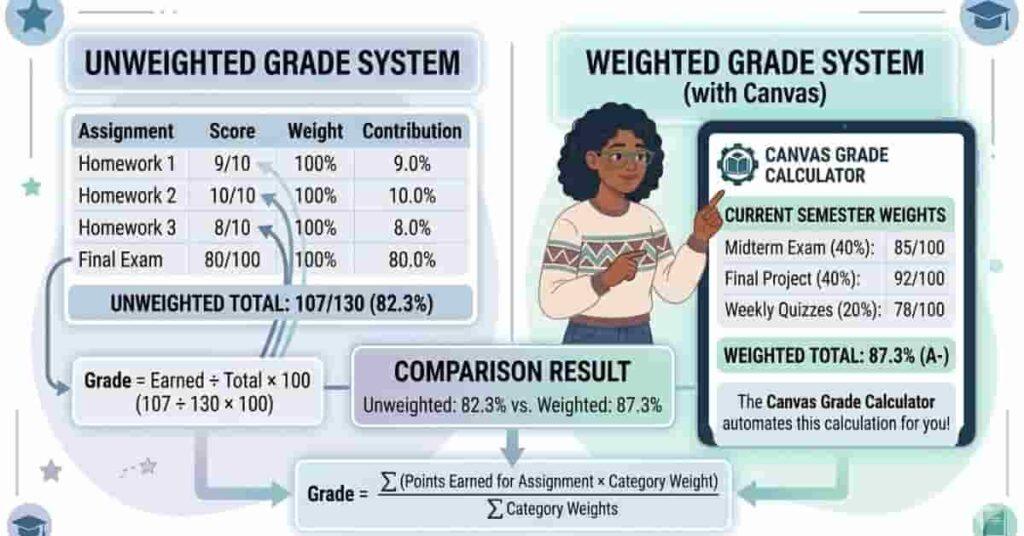
Understanding how grades are calculated in Canvas LMS helps students track their academic performance more accurately. Canvas usually calculates course grades using either a weighted grading system or an unweighted point-based system. The method depends on how the instructor has configured the course settings.
By understanding whether your course uses weighted or unweighted grading, you can better estimate your progress. Let’s look more closely at how each grading system works in Canvas.
Weighted Grade System in Canvas
In many courses, Canvas uses a weighted grading system, where each category contributes a set percentage to the final grade.
For example:
| Category | Weight |
|---|---|
| Homework | 25% |
| Quizzes | 15% |
| Midterm | 30% |
| Final Exam | 30% |
Note: These percentages represent how much each category contributes to the overall course grade.
For instance, if homework is worth 25% of your grade and you score 90% in homework, you would calculate 0.90 (homework score) x 25 (homework weight) = 22.5. This 22.5% contributes to your final grade. If quizzes are 35% of your grade and you score 80%, you would calculate 0.80 x 35 = 28. Add the contributions from all categories for your final grade percentage.
This approach helps instructors emphasise more important assessments, such as midterms or final exams.
Unweighted Grade System
Some courses use an unweighted point-based system. Here, Canvas totals the points earned for all assignments.
The basic formula is:
Grade = Earned Points ÷ Total Points × 100
Example:
| Assignment | Score | Total |
|---|---|---|
| Homework | 85 | 100 |
| Quiz | 40 | 50 |
Note: You can calculate the percentage for each assignment using Score ÷ Total × 100.
For example, if you earn 30 points for Homework 1, 45 points for Quiz 1, and 50 points for the Final Exam (out of 40, 50, and 60 possible points, respectively), your total earned points are 30 + 45 + 50 = 125. The total possible points are 40 + 50 + 60 = 150. Canvas divides your earned points by the total possible points: 125 / 150 = 0.833, or 83.3%.
This method is straightforward because every point contributes directly to the final grade.
Extra Credit and Dropped Assignments
Canvas allows instructors to adjust grades using additional settings, which can affect your final calculation.
For example, if you have 120 out of 150 points and complete an extra credit assignment worth 5 points, your new score is 125 out of 150 points. Canvas will now calculate your percentage as 125 / 150 = 83.3%. The extra credit increases your score without changing the denominator.
Some courses also apply dropped assignment rules, where the lowest quiz or homework score is automatically removed from the calculation. This helps students avoid being heavily penalised for one poor performance.
Instructors may also include optional assignments that allow students to improve their grade by completing additional work. Understanding these rules helps students estimate their grades more accurately.
Example sentence: If your instructor hides totals, you can learn how to track grades manually in Canvas for accurate results.
How a Canvas Grade Calculator Works
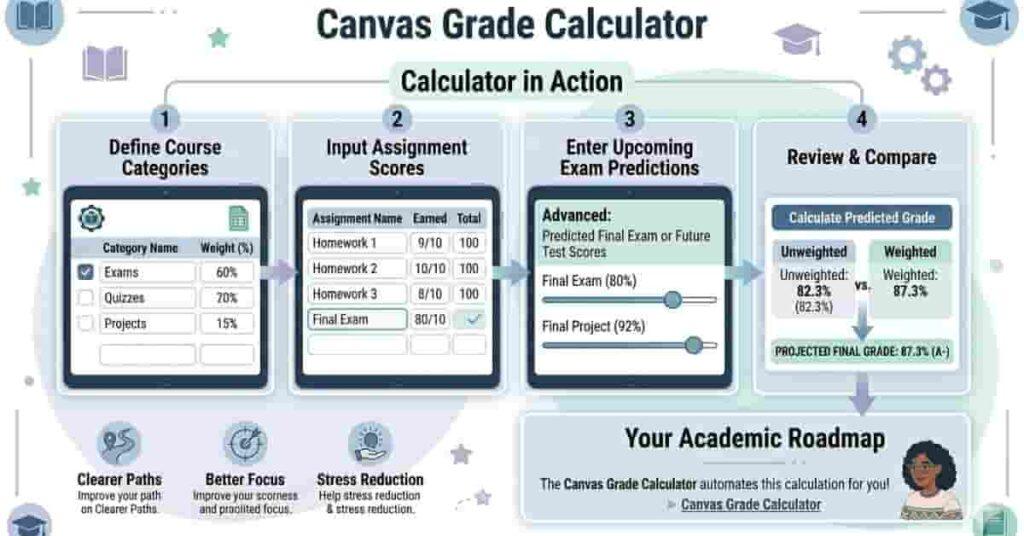
A Canvas grade calculator helps students quickly estimate their course performance without doing complex math. Instead of manually calculating percentages, the tool follows the same grading logic used in Canvas LMS. By entering a few details from your course gradebook, you can instantly see your current grade or predict your final result.
Below is a simple step-by-step explanation of how most Canvas grade calculators work.
Step 1: Enter Assignment Scores
Start by entering the scores you received on completed assignments. These may include homework, quizzes, projects, or exams. Most calculators allow you to enter either points earned or percentage scores depending on how your course displays grades.
This information forms the base of your current grade calculation.
Step 2: Add Category Weights
Next, enter the weight of each grading category if your course uses weighted grading. For example, homework might count for 25%, quizzes for 15%, and exams for a larger portion of the final grade.
The calculator uses these weights to determine how much each category contributes to your overall course percentage.
Step 3: Include Upcoming Exam Scores
Many students want to estimate their future performance before important tests. A grade calculator allows you to enter expected scores for upcoming assignments or final exams. This helps you understand how those scores could affect your overall grade.
Step 4: Calculate Current or Final Grade
After entering all required information, the calculator processes the data and shows your current course percentage or predicted final grade. The result updates instantly, allowing you to experiment with different score possibilities.
This feature is especially useful for “What-If” scenarios. For example, you can test what grade you would need on a final exam to reach a target course grade, such as 85% or 90%.
Practical Example: Calculating a Canvas Course Grade
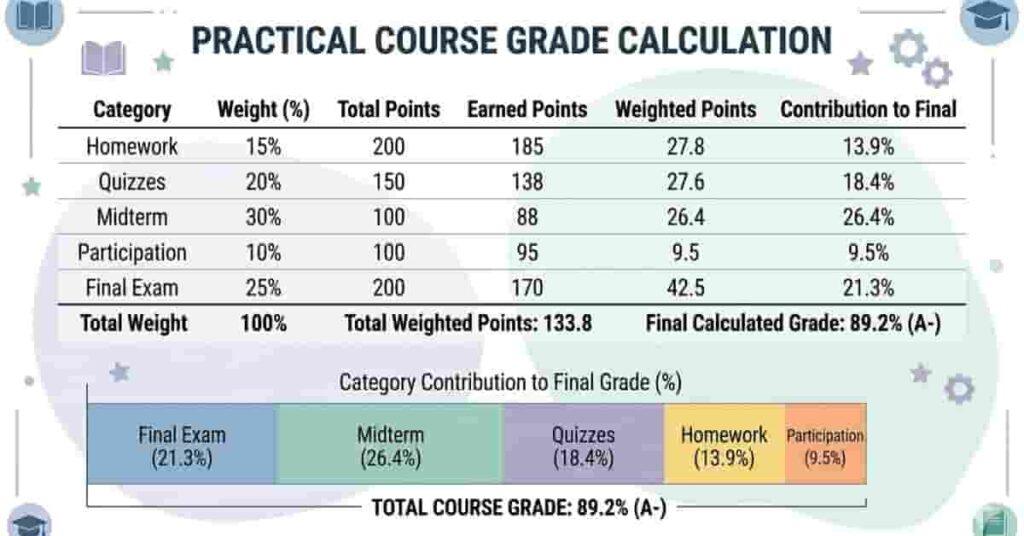
Here’s an example of how Canvas LMS calculates grades using weighted categories.
| Category | Score | Weight |
|---|---|---|
| Homework | 88% | 25% |
| Quizzes | 92% | 15% |
| Midterm | 85% | 20% |
| Participation | 95% | 10% |
Note: Weighted grade can be calculated using Score × Weight for each category and then summing all.
Step 1: Convert Each Category to a Weighted Score
First, multiply each score by its category weight.
- Homework: 88 × 0.25 = 22.0
- Quizzes: 92 × 0.15 = 13.8
- Midterm: 85 × 0.20 = 17.0
- Participation: 95 × 0.10 = 9.5
Step 2: Add All Weighted Scores
Now add the weighted values:
22.0 + 13.8 + 17.0 + 9.5 = 62.3
This means the student has earned 62.3% of the total weighted grade so far.
Step 3: Adjust for Remaining Course Weight
These categories make up 70% of the course grade. Divide the total by 70% to get the current percentage.
Current Grade = 62.3 ÷ 0.70 = 89%
This means the student’s current grade is approximately 89% before accounting for the remaining assignments or final exam. As a result, the student’s current grade can be quickly estimated manually, as Canvas does automatically.
When Students Should Use a Canvas Grade Calculator

A Canvas grade calculator enables Canvas LMS students to gauge their progress and strategize academically at crucial stages of a course. Below are common scenarios when a grade calculator proves beneficial.
Before Final Exams
As the semester approaches the final exam period, many students calculate what score they need to achieve their target grade. A Canvas grade calculator shows the exact percentage required on the final exam to reach a specific course grade.
When Planning GPA Improvement
Students aiming to improve their overall academic performance track their grades carefully. A calculator shows them how each assignment or test affects their final course percentage.
When Instructors Hide Total Grades
In some courses, instructors disable the total grade display in Canvas. This prevents students from easily seeing their overall percentage. A grade calculator helps them estimate their current grade based on available assignment scores.
When Calculating “What-If” Grades
One of the most helpful features is testing “what-if” scenarios. Students can enter possible scores for upcoming assignments or exams to see how different outcomes might affect their final grade. This helps them set realistic study goals and prioritise important assessments.
Common Mistakes Students Make When Calculating Grades
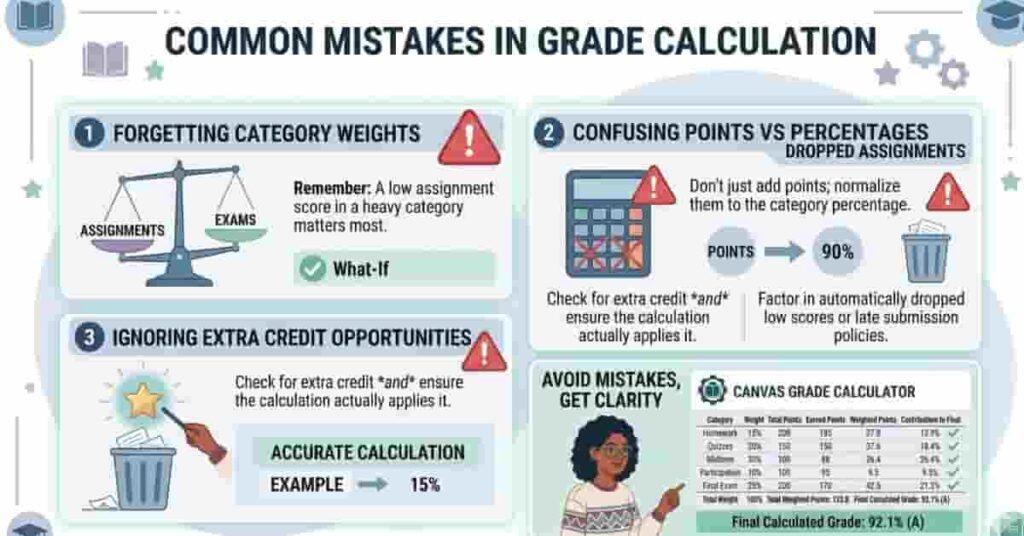
Even with a Canvas grade calculator, students can make simple mistakes that affect the accuracy of their estimated grades. Understanding these pitfalls improves your grade tracking skills and ensures your calculations are reliable.
Forgetting Assignment Weights
Weighted grades give different importance to each category, like homework, quizzes, or exams. Ignoring these weights can lead to a major miscalculation of your final grade.
Ignoring Extra Credit
Some courses offer bonus points that add to your overall percentage. Not including extra credit in calculations can underestimate your actual performance.
Confusing Percentage vs Points
Many students mix up raw points with percentages. For example, scoring 45 out of 50 is 90%, not just 45%. Always convert points to percentages when using a calculator.
Not Counting Dropped Assignments
Canvas can automatically drop the lowest scores in certain categories. Failing to account for this can either overstate or understate your current grade.
By avoiding these common mistakes, students can make the most of a Canvas grade calculator and get a clear, accurate view of their academic progress.
Canvas Grade Calculator vs Manual Grade Calculation
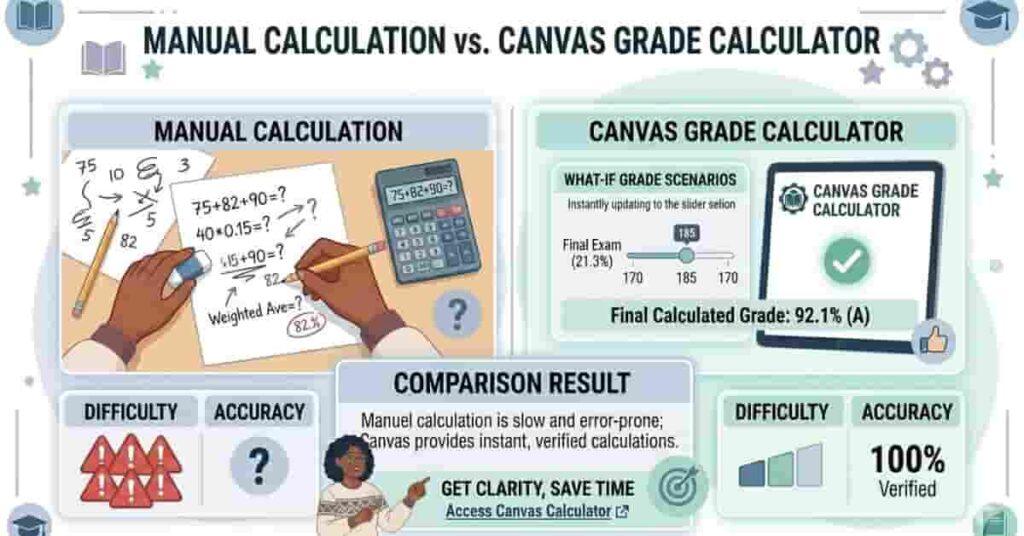
Manual grade calculation is slow and often inaccurate, while a Canvas grade calculator offers fast, reliable results.
Here’s a quick comparison:
| Method | Difficulty | Accuracy |
|---|---|---|
| Manual calculation | Medium | Risk of mistakes |
| Grade calculator | Easy | Highly accurate |
Note: Using a grade calculator simplifies the process and reduces the chance of errors compared to manual calculation.
Students add scores, apply weights, and adjust for extra credit or dropped assignments when they calculate grades manually. They often make mistakes, and the process takes significant time.
The tool calculates everything automatically. You enter your scores and weights, and it provides your current or predicted grade. You save time, avoid errors, and plan ‘what-if’ scenarios for exams or assignments.
When students use a calculator, they focus on studying rather than crunching numbers, making academic planning much more efficient.
Example sentence: For a detailed method, check our guide on calculating final and dropped grades in Canvas to ensure you never miss any points.
Conclusion
In this guide, we explored what a Canvas grade calculator is, how Canvas calculates grades, and how weighted and unweighted grading works. We also covered practical examples, common mistakes, and when students should use a calculator to track their progress.
Using a Canvas grade calculator helps students save time, avoid errors, and understand their course performance clearly. Whether you want to plan for a final exam, check “what-if” scenarios, or simply track your current grade, this tool makes academic planning much easier.
Don’t wait to guess your grades—try our Canvas Grade Calculator today and see exactly where you stand. Share your experience in the comments or explore more guides to improve your GPA and study strategy.
This simple tool empowers beginners in the USA to stay on top of their grades and achieve their academic goals confidently.

Hi, I’m Zohaib Ali, a BS-IT student at the University of Engineering and Technology. 🎓 I created CanvasGradeCalculator.com to make grade and GPA calculations simple, accurate, and stress-free for students, teachers, and parents. Passionate about tech and education, Helping learners plan smarter, study better.