

Introduction
Ever finished an assignment and wondered, “Did my professor grade it yet?” You’re not alone. Many students across the U.S. struggle to find their grades or understand what Canvas actually shows.
Learning how to check grades on Canvas is one of the first skills every new student should master. Whether you’re taking online classes or using a school’s Canvas portal, knowing where to look—and what those Canvas gradebook symbols mean—can make a big difference in your confidence and performance.
This guide walks you step-by-step through everything you need to know: how to view grades, read feedback, and track your progress using the Check Canvas grades app. You’ll also discover how to interpret your Canvas grade history, understand your final grades in Canvas, and troubleshoot when scores don’t appear.
By the end, you’ll feel completely comfortable navigating Canvas like a pro. No more guessing or waiting anxiously—just clear, accurate grades at your fingertips. Let’s dive in and make checking grades simple, stress-free, and 100% accurate.
How to Check Grades on Canvas (Step by Step)
Knowing how to check grades on Canvas helps you stay organized and avoid end-of-semester surprises. Whether you’re tracking daily progress or waiting for final grades, Canvas makes it easy to see where you stand. You can check grades on both the desktop and the Canvas mobile app, though the layout differs slightly.
Here’s how to apply this effectively:
On Desktop
The desktop version of Canvas gives the clearest view of your course progress and grade details.
Log in to Canvas.
- Click “Courses” on the sidebar and pick your course.
- Select “Grades” from the course menu.
- View assignments, grades, and feedback.
- For all courses, return to the dashboard and select “View Grades.”
Each course may calculate grades differently, using specific weighting rules for assignments or categories. This means your “current grade” shown in Canvas may not always match your final grade. If your instructor hides total grades, you’ll see a dash (—) instead of a percentage — this is one of the common Canvas gradebook symbols.
Pro Tip: Bookmark “Grades” for easy access every time you log in.
On Canvas Mobile App
The Canvas app is great for fast grade checks. Navigation is different from desktop.
Open the Canvas Student App on your device. Tap the menu icon (☰) and select “Courses.”
- Choose a course and tap “Grades.”
- Scroll to see assignment scores and feedback. For overall grades, go back to the dashboard and tap “View Grades.”
The Check Canvas grades app experience is faster but offers fewer details than the desktop — for example, you might not see full grade history or weighting. Still, it’s perfect for quick updates and tracking progress during the semester.
Pro Tip: Turn on notifications to get grade alerts instantly.
“Once you’ve checked your grades, try the Canvas Grade Calculator to predict your GPA and see how future assignments could impact your totals.”
How to Check All Grades vs Final Grades
When checking grades on Canvas, understand the difference between current and final grades. Canvas displays various totals based on your instructor’s settings, assignment weights, and dropped scores, which can lead to confusion if your Canvas grade and transcript don’t match.
By recognizing these key differences, you’ll be better prepared as you continue through each section below.
Here’s how to apply this effectively:
“Curious how your current scores translate to your final grade? Use the Canvas Grade Calculator to get instant GPA predictions.”
“For example, Alex, a 10th grader, thought he was failing. By comparing his current grades and using the Canvas Grade Calculator, he realized his final grade would actually be an A–. Small checks like this can prevent unnecessary worry.”
“Want to see how your scores compare to your classmates? Try our Class Rank Calculator to find your academic standing instantly.”
Difference Between “Current Grade” vs “Final Grade” in Canvas
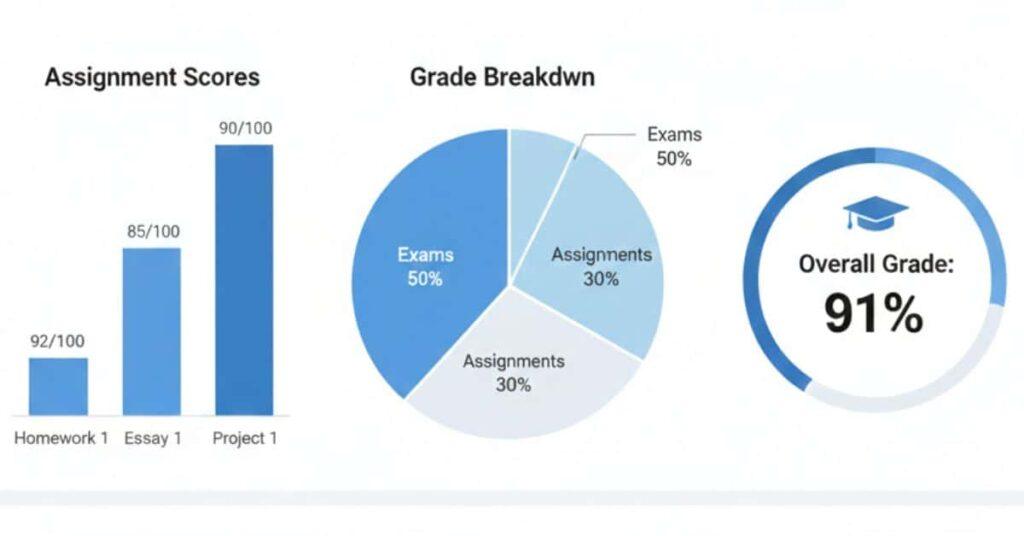
Canvas uses two grading views: Current Grade and Final Grade. “Current Grade” is your total based only on assignments that have been graded so far. “Final Grade” represents your grade if all assignments, including those not yet submitted, are counted as zero.
- Current Grade shows your average for assignments already graded (excluding anything not submitted or graded yet).
- Final Grade includes all assignments, even unsubmitted ones, offering a complete picture.
Your final grade may drop if Canvas counts unsubmitted work as zero. When checking, note both “Total” and “Final” labels. Canvas gradebook symbols, like a dash (—), signal missing or ungraded items impacting your total.
💡 Pro Tip: Use the Check Canvas grades app to see both grades side by side if your instructor allows full visibility.
How Weighting and Dropped Assignments Can Change What You See
Canvas courses often use weighted grading systems. That means some categories—like quizzes, projects, or exams—count more than others.
For example:
| Quizzes | 20% | Raises score slightly |
| Projects | 40% | Major influence on total |
| Exams | 40% | Can significantly shift grade |
Dropped or excused assignments can also shift totals. If your teacher drops your lowest quiz, Canvas recalculates grades automatically. However, this might not appear instantly in your Canvas grade history.
💡 Pro Tip: Check your course syllabus to confirm if grades are weighted before comparing current and final grades.
Where to Locate Final Grades
You can find your final grades in Canvas through the dashboard or the “View Grades” section.
Steps:
- Go to your Canvas Dashboard.
- Click “View Grades” under your enrolled courses.
- Look for the column labeled “Total” or “Final Grade.”
If you only see current grades, your instructor may have hidden final totals until grading is complete. Some institutions also move final grades to a separate portal.
💡 Pro Tip: Take screenshots or export grades to track changes over time — it helps compare results later using tools like the Canvas Grade Calculator.
Why Professors Sometimes Hide Final Grades Until the End
Instructors may hide final grades in Canvas for several reasons:
- They’re still grading late or revised submissions.
- They want to prevent confusion before grade adjustments.
- Some schools require final approval before release.
When grades are hidden, you’ll often see the muted grade icon — one of the Canvas gradebook symbols that signals limited visibility.
If you’re unsure whether grades are final, check your Canvas grade history or contact your instructor. The hidden setting ensures fairness but can delay results briefly.
💡 Pro Tip: Don’t panic if you can’t see final grades right away — they’ll appear once your instructor publishes them.
How to View Past Grades and Grade History
When checking grades on Canvas, many students view only current courses. But Canvas lets you see past results and grade changes, helping you track progress, confirm instructor updates, and compare grades across terms.
This feature is useful when preparing for GPA checks or verifying post-grading corrections.
Here’s how to apply this effectively:
Accessing Past Semester Grades in Canvas
Canvas organizes course records by term for easy access to previous grades.
Follow these steps to view past semester grades:
- Log in to your Canvas dashboard.
- Click “View Grades” on the sidebar.
- Open the dropdown menu next to your name.
- Select the term to review.
- You’ll see your course list and final grades for that term.
This section is read-only, so you can’t edit grades, but it’s ideal for tracking past performance or sharing with advisors.
💡 Pro Tip: The Check Canvas grades app may not show older terms, so use the desktop version for full visibility.
Gradebook History Feature: What It Shows
Gradebook History tracks instructor changes by assignment and date.
To access it:
- Go to any course.
- Click Grades → Gradebook History.
- Use filters for date or student (if available).
This is useful if you notice grade adjustments or missing feedback. You’ll see a timeline of edits to confirm updates.
💡 Pro Tip: Use Canvas grade history to double-check if late penalties or resubmissions were graded fairly.
Limits: When Canvas Does Not Display Archived Grades
Canvas isn’t a permanent record system. Some institutions remove or hide older data after a few semesters, causing archived courses to disappear from your dashboard or grades list.
If you can’t find a past course:
- Check your school’s student portal or transcript system.
- Contact the Canvas administrator for reactivation.
- Verify you’re using the correct login credentials.
💡 Pro Tip: Export your grades at the end of each term to avoid losing access later — a good habit for record-keeping and GPA planning.
Why Grade History Can Differ from Transcript
Canvas grade history may differ from your transcript, as Canvas shows real-time grades and transcripts reflect verified, approved results.
Some reasons for differences include that Canvas grades may be adjusted for rounding before the final transcript submission, and only the finalized grade will appear on your transcript.
- Instructor overrides or corrections.
- Assignments dropped in Canvas might not yet be updated in your transcript, leading to a temporary mismatch between the two records.
If your Canvas grades don’t match your transcript, confirm with your instructor before appealing.
💡 Pro Tip: Use Canvas gradebook symbols (like “EX” or “—”) to understand what may be excluded before comparing your results.
Canvas Grade Book Symbols & What They Mean
When checking grades on Canvas, you’ll see small icons next to your scores. These symbols explain grading actions, such as excused work, late submissions, or hidden results. Understanding them makes it easier to track your progress and avoid confusion.
Each symbol shows specific information, such as whether your work is missing, excused, late, not graded yet, or if your grade has been temporarily hidden by the instructor. Understanding what these mean prepares you for the most accurate tracking of your progress in Canvas.
Here’s how to apply this effectively:
Common Symbols in Canvas Gradebook
Canvas uses different icons, such as a dash (—) for not-yet-graded items, an “EX” for excused work, a lock or speaker for muted or hidden grades, and various marks for late or missing submissions. Below is a table of the most common Canvas gradebook symbols and what they mean:
| — | No grade entered yet | May be pending or excluded |
| EX | Excused from assignment | Doesn’t affect total grade |
| 🔺 / ⏰ | Late submission | Points deducted based on policy |
| 🚫 | Missing assignment | Counts as zero unless changed |
| 🔇 | Muted grade | Hidden until instructor publishes |
These symbols appear both on desktop and in the Check Canvas grades app, though visibility can vary by instructor settings.
Pro Tip: Hover over icons for quick descriptions.
How to Interpret Canvas Symbols Correctly
Gradebook symbols each have specific meanings. For instance, a dash (—) means the work hasn’t been graded, not a zero. A muted icon shows that a grade is present but hidden until released.
To interpret grades correctly:
- Wait for the instructor to publish hidden grades before assuming totals.
- Check if an “EX” mark appears—it means the work is excused, not missing.
- Recalculate your grade using tools like the Canvas Grade Calculator if needed.
Pro Tip: Check grade history after assignments update.
Mistakes Students Often Make with Symbols
Many students misread Canvas gradebook symbols, leading to unnecessary stress or false assumptions. Common mistakes include:
- Thinking a dash (—) means a zero.
- Ignoring muted icons and assuming grades are final.
- Overlooking late or missing icons that affect totals.
- Forgetting that excused (EX) work isn’t counted at all.
Misunderstanding symbols can cause confusion when comparing Canvas grades to official records. Review gradebook notes regularly and confirm with your instructor if something seems off.
Pro Tip: After grading, check for muted or missing icons.
Troubleshooting: When You Can’t See Your Grades
Students learning to check grades on Canvas may notice grades not appearing as expected. This can be due to instructor settings or technical glitches. Knowing the possible causes helps resolve these issues quickly and avoid stress.
If grades don’t load, don’t panic. Canvas offers ways to identify the problem and who to contact.
Here’s how to apply this effectively:
Grades Not Showing: Possible Reasons
When grades don’t appear in your Canvas dashboard, it usually means:
- The instructor hasn’t graded the assignment yet.
- Grades are hidden or muted.
- The course term has ended, and access is limited.
- You’re viewing the wrong course section or term.
Always check if the Check Canvas grades app matches your desktop view — some updates sync late. If both show missing data, the issue is likely on the instructor’s side, not yours.
💡 Pro Tip: Compare your grades across devices and confirm the course is published before assuming something’s missing.
Instructor Settings (Hidden / Muted Grades)
Canvas allows teachers to hide grades until they’re ready to release them. When this happens, you’ll see muted icons or blank spaces instead of scores — one of the most common Canvas gradebook symbols.
These settings protect grading privacy or prevent confusion during regrading. Once grades are published, you’ll receive a notification or see the muted icon disappear.
If your final grades in Canvas are hidden, wait until the end of the term or contact your instructor for clarification.
💡 Pro Tip: Look for the “eye with slash” icon — it means grades are hidden, not missing.
Technical Issues (Browser/App Cache, Update Problems)
If grade pages won’t load, try clearing your browser cache or cookies.
- Update the Canvas grades app to the latest version.
- Switch to a different browser, such as Chrome, Firefox, or Safari.
- Checking internet stability.
If grades show on one device but not another, refresh, clear cache, and log in again.
💡 Pro Tip: Avoid using outdated browsers — Canvas may not display your Canvas grade history correctly if the versions are incompatible.
Who to Contact (Professor vs Canvas Support)
If you’ve checked everything and grades are still missing, it’s time to reach out for help.
- Instructor: Contact them first if you believe an assignment hasn’t been graded or is hidden.
- Canvas Support: Contact support for technical issues like blank pages, login errors, or missing course access.
Provide screenshots, course details, and assignment names to speed up the resolution. Always stay polite and clear when describing the issue.
💡 Pro Tip: Use the Canvas “Help” button (bottom-left menu) to directly report visibility problems or missing Canvas gradebook symbols.
Pro Tips for Tracking Your Grades in Canvas
Once you know how to check grades on Canvas, the next step is tracking them smartly. Staying proactive helps you catch errors, predict your final grades, and plan your study schedule. Canvas offers built-in tools for easy monitoring, whether on the desktop or with the Check Canvas grades app.
By using “What-If Grades,” exports, and notifications, you can stay informed about every update.
Here’s how to apply this effectively:
“Combine these tips with the Canvas Grade Calculator to plan your study strategy and track GPA growth effortlessly.”
Use the “What-If Grades” Feature to Predict Outcomes
The What-If Grades tool lets you test various grade scenarios without changing your actual results. It is ideal for exploring how future assignments may impact your final grade.
To use it:
- Go to your course Grades page.
- Click any assignment score and type a new value.
- Canvas instantly recalculates your total.
This feature helps visualize how missing or low grades impact your average. Use it to plan which assignments need extra focus.
💡 Pro Tip: When using the What-If Grades feature, pair it with the Canvas Grade Calculator to estimate GPA changes across multiple courses.
Export Grades to Excel or Google Sheets
Exporting grades provides a clearer long-term view. It is useful for analyzing trends or creating charts.
Steps to export:
- Open your Grades tab.
- Click the Export button (top right).
- Choose CSV or Google Sheets format.
You’ll receive a complete list of scores, including assignment weights and symbols. Keep these files for backup or to track your progress across semesters.
💡 Pro Tip: After exporting your grades, add columns in your sheet to compare Canvas totals with transcript data or your Canvas grade history.
Set Up Canvas Notifications for New Grades
Canvas can notify you whenever an instructor posts or updates a grade. This prevents missing important or late updates.
To enable notifications:
- Click your profile icon → Notifications.
- Find “Grading” and choose Immediately or Daily Summary.
- Save your settings.
You’ll receive alerts in the app or by email.
💡 Pro Tip: During finals week, keep notifications turned on because that’s when final grades in Canvas are updated most often.
Cross-Check with Syllabus Grading Policies
The syllabus defines how grades are weighted and calculated, which may sometimes differ from the information in Canvas. Confirm your instructor’s grading breakdown before considering totals as final.
When checking:
- Compare syllabus weights to Canvas categories.
- Note if the lowest scores or late penalties are dropped.
- Ask instructors if the results look inconsistent.
This approach prevents confusion and clarifies why your grade may shift before submission.
💡 Pro Tip: If you notice your Canvas grade history doesn’t match the syllabus, email your professor before the grading period ends to clarify any issues early.
“Pair the Canvas Grade Calculator with exported grades from Canvas. This way, you can visualize trends, predict outcomes, and spot potential issues before they affect your GPA.”
conclusion
In this guide, we covered everything you need to know about checking your grades on Canvas. You learned how to navigate both desktop and mobile, interpret Canvas gradebook symbols, review Canvas grade history, and track your final grades in Canvas.
Understanding how to check grades on Canvas helps you stay on top of your coursework and avoid surprises at the end of the semester. With these tips, you can confidently monitor your progress and make informed academic decisions.
Now it’s your turn! Use the Check Canvas grades app or desktop portal to explore your grades today. Share your experiences in the comments or let others know which tips helped you the most. For more helpful resources, explore our website and keep your academic journey smooth and organized.

We are the Canvas Academic Team, a developer team focused on building simple and practical tools that help students succeed academically. This platform was created specifically for Canvas LMS students to make grade tracking, GPA calculations, exam planning, and academic management easier and more efficient.
Our focus is on creating fast, accurate, and student-friendly educational tools along with helpful learning resources that improve productivity and reduce academic stress.
Through CanvasGradeCalculator.com, our goal is to continue building useful resources that help students study smarter, stay organized, and achieve better academic results.